A 125-year-old retailer leans on software for a human service
Nordstrom announced a holiday app refresh on Monday that centers on an AI-backed feature called Request a Look, which gives shoppers personalized styling recommendations inside the app, with the option to escalate to one-on-one support from a human stylist. The feature arrives alongside a new in-store mode with an interactive map to help shoppers navigate physical stores, and an expanded Gift Edit catalog carrying expert commentary and improved filtering across more than 1,000 holiday gift items. The company also reimagined its longtime marketing character Nordy, pairing it with a new sidekick named Disco, as part of a broader campaign marking Nordstrom's 125th anniversary this year.
The styling substitution matters more than the map. Personal styling has long been one of Nordstrom's signature in-person services, staffed by associates whose expertise is part of the brand's premium positioning. Putting an AI layer in front of that service, with human stylists reserved for shoppers who specifically ask for escalation, is a direct bet that software can handle the bulk of styling requests that used to default to a human by default.
Fulfillment speed gets the same treatment as styling
Nordstrom is also launching same-day beauty delivery in more than 15 markets starting in October, including Los Angeles, New York, Chicago, San Francisco, and Miami. That expansion puts Nordstrom's beauty category on the same kind of rapid-fulfillment footing that grocery and mass retail have been racing toward for the past two years, and it signals the company sees speed as a competitive requirement in a category where Sephora and Ulta already compete hard on convenience. Beauty is also one of the few categories where Nordstrom competes directly against pure-play specialty chains rather than other department stores, which raises the stakes on getting delivery speed right.
Combined with the app's styling and navigation features, the pattern is consistent: Nordstrom is investing in software that compresses the time and staffing a shopper previously needed to get a personalized, fast outcome, whether that outcome is a styled outfit or a lipstick delivered same-day. Each of these is a smaller bet individually, but together they represent a retailer systematically replacing service touchpoints with software across an entire holiday season.
The FAO Schwarz partnership adds scale, not just novelty
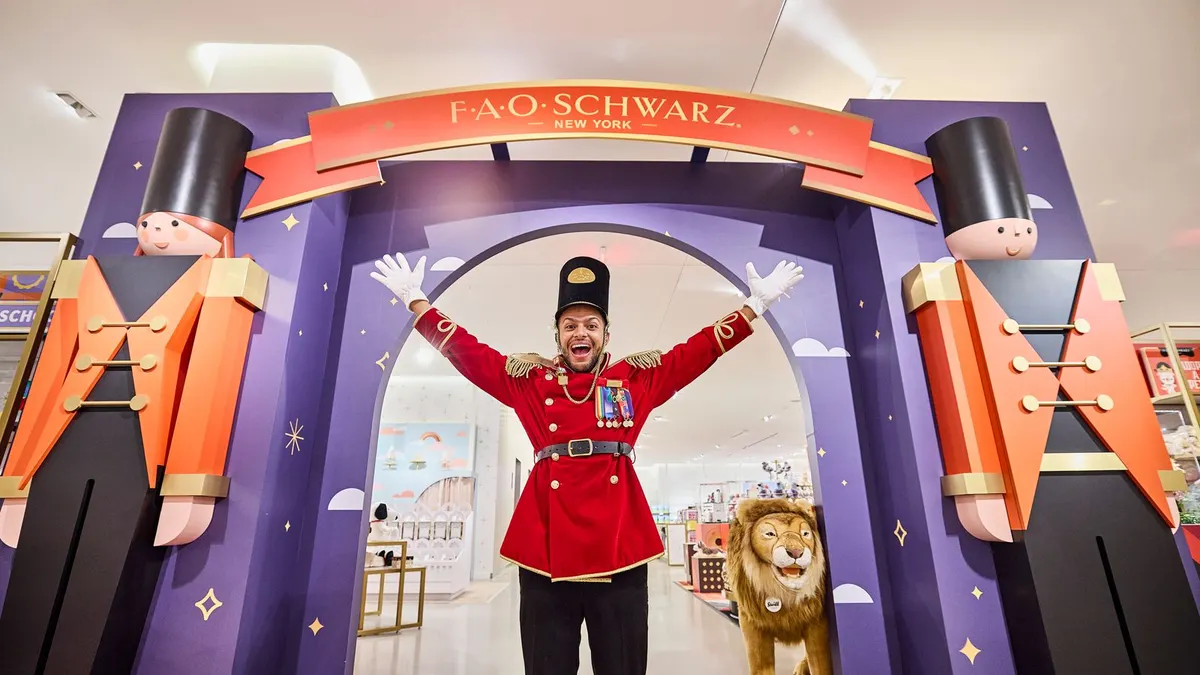
The app changes land alongside an expanded FAO Schwarz partnership, first announced in June, now rolled out to every Nordstrom location for the holidays with shop-in-shops in some stores and an expanded presence on Nordstrom's website. FAO Schwarz itself opened an ecommerce storefront on Amazon last month, and its flagship store in New York's Rockefeller Center will host an Amazon pop-up featuring items from Amazon's 2026 top toy list, which puts Nordstrom's toy partner in a visible commercial relationship with Amazon at the same time it is deepening its tie to Nordstrom.
That triangulation, FAO Schwarz selling through Nordstrom stores and through an Amazon storefront simultaneously, says something about how toy and specialty brands are hedging distribution risk this holiday season rather than betting on a single retail partner. For Nordstrom, hosting FAO Schwarz in every location functions as a traffic and differentiation play layered on top of the app investment, giving shoppers a reason to visit a physical store even as the company pushes more of the actual transaction and styling experience into software. The two bets reinforce each other: foot traffic from the toy partnership feeds the same stores where the app's new navigation and styling features are meant to convert that visit into a sale.
What the AI styling bet is actually testing
Nordstrom has not published acceptance rates, satisfaction scores, or escalation-to-human rates for Request a Look, and a Dive Brief-style product announcement is not the venue where those numbers would appear. But the structural choice, AI recommendations as the default path with human stylists as the fallback rather than the default, is the real experiment here, and it is one every department store and specialty retailer offering styling services is watching.
The bar for success is not whether the AI recommendations are good in isolation. It is whether they are good enough that shoppers do not routinely escalate to a human, because every escalation is a signal that the software substitution failed to clear the quality threshold a premium retailer's brand depends on. If escalation rates run high, Nordstrom has simply added a software step in front of the same labor cost. If they run low, it has found a genuine way to scale a signature service without scaling headcount.
The decision other retailers should be making in parallel
Any retailer currently staffing seasonal associates for personalized service work, styling, gift concierge, product advice, should be running the same cost-benefit Nordstrom just made public: what fraction of those interactions can an AI recommendation layer handle well enough that a human escalation path, rather than a human default, is the right design. That answer depends entirely on how good the underlying recommendation model is for a specific retailer's catalog and customer base, which is not something a vendor demo will reliably predict.
The honest move for a retail CIO evaluating this trade is to pilot the AI-first, human-escalation model on a narrow segment of a storefront or category this holiday season, measure escalation rates against a control group still defaulting to human staff, and let that data, not the appeal of headcount savings, decide whether to scale the approach. Nordstrom is running that experiment at full scale in public. Smaller retailers have the option to run it smaller and learn before committing.