A quarter of the workforce, one earnings cycle
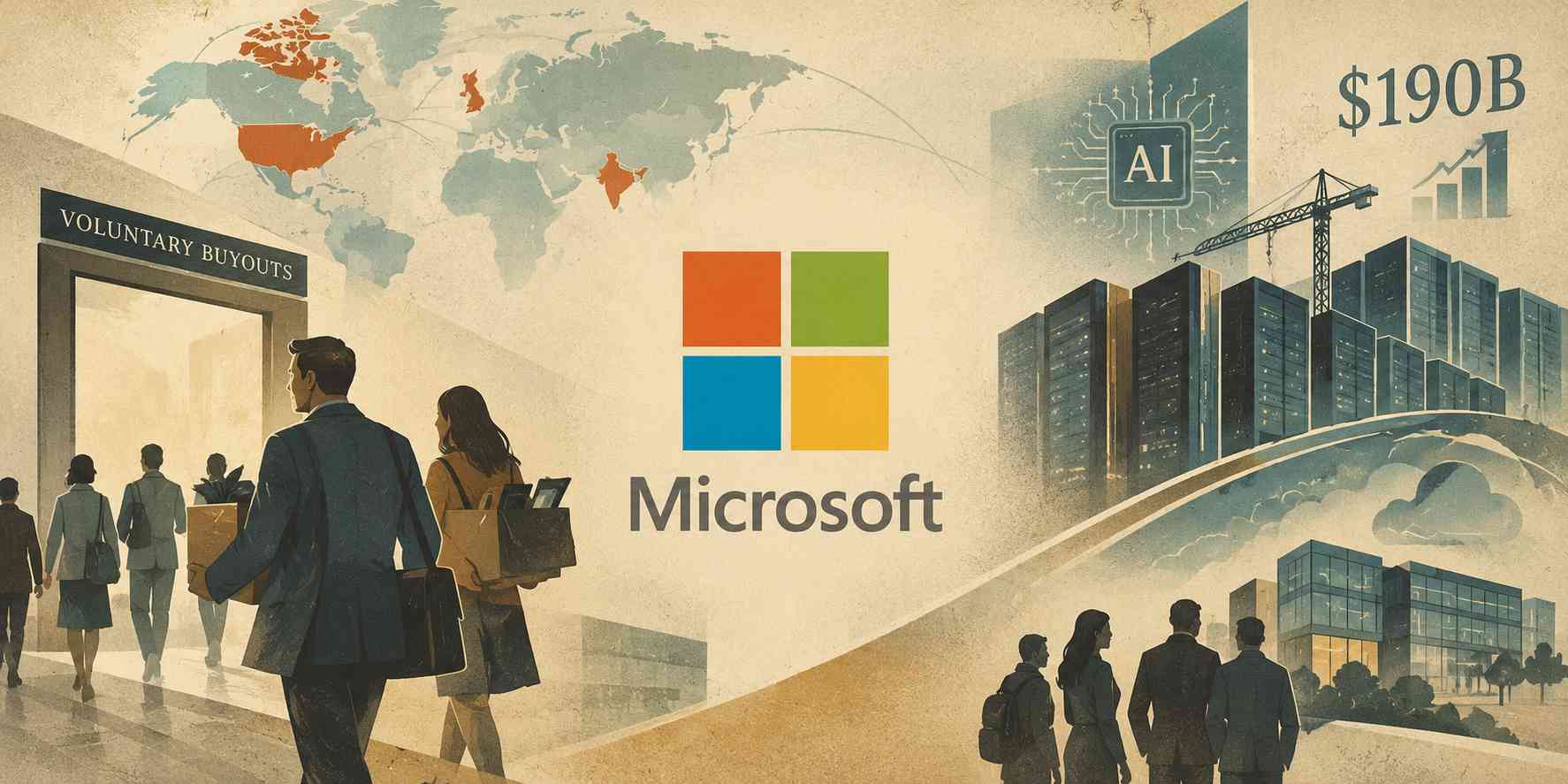
Microsoft confirmed it is offering voluntary exit packages to approximately 60,000 employees, a figure the company and multiple outlets put at roughly 27 percent of its global workforce. Eligible staff span the US, Canada, the UK and India, at job level 70 and below, and the eligible population includes employees in Copilot, finance, HR and Xbox, while some marketing, commercial and security teams were excluded from the offer entirely. Employees have until early December to decide, with departures set to take effect December 31, 2026, giving affected staff roughly a month to make a decision that reshapes their year ahead.
Chief People Officer Amy Coleman described the move in an internal memo as something new for the company, writing that Microsoft will learn from it as the program runs its course. Microsoft has disclosed neither how many employees it expects to accept the offer nor the savings the program is meant to produce. The timing carries its own weight: the offer surfaced the same week Microsoft reported Q1 FY2027 earnings, the identical report in which it disclosed its scaled-up capital spending plan for the year ahead.
Where the money is actually going
Microsoft's capital spending guidance for 2026 sits at roughly 175 to 190 billion dollars, covering data centers, specialized AI hardware, cooling and energy infrastructure. That spending underwrites Azure's expansion and AI features such as Microsoft 365 Copilot, and it also funds the compute capacity Microsoft sells to AI developers including OpenAI. Microsoft has left the connection between the buyout program and that budget unstated in its own disclosures, yet the two numbers sit in the same earnings release, filed by the same finance organization, in the same reporting week.
Readers can draw their own conclusion from the proximity of the two figures. In the same reporting period, Microsoft is reducing committed labor cost while locking in near-record committed capital cost, and both moves flow through the same corporate balance sheet toward the same strategic priority. This is not an isolated pattern at Microsoft specifically. Oracle, Amazon and Meta are each cutting jobs in the same window while simultaneously increasing AI spending, a sector-wide signal rather than a company-specific one.
This is not Microsoft's first pass at this
Microsoft had already run a smaller voluntary early-retirement offer to about 8,750 US employees, of whom roughly 30 percent accepted, and followed that about three months later with a separate cut of roughly 4,800 jobs. The 60,000-person offer now underway is explicitly described as separate from those earlier actions, which suggests the company is iterating on workforce reduction mechanisms across the year rather than executing one single planned cut and moving on.
Microsoft had about 223,000 full-time employees as of the end of June, which puts the current offer's scope at a genuinely large share of total headcount, even accounting for the likelihood that not everyone eligible will take it. For a company whose public identity rests on AI-era growth, the scale of the offer is itself a data point about how seriously leadership is treating the trade-off between people cost and infrastructure cost at a moment when both are rising fast.
A sector-wide reallocation, not an isolated Microsoft decision
Per Challenger, Gray and Christmas data cited alongside the Microsoft announcement, technology accounted for roughly 30 percent of all announced job cuts across the US economy in 2026, a sector-wide signal that capital reallocation toward AI infrastructure has become a standard board-level move rather than a one-off response to a specific company's troubles. Oracle, Amazon and Meta appear in the same reporting cycle making comparable trade-offs between headcount and infrastructure spend, each at its own scale and on its own timeline.
That pattern suggests boards across the largest technology companies have independently reached a similar conclusion: the marginal dollar currently creates more competitive advantage deployed toward AI infrastructure than toward incremental headcount in many functions. Enterprises watching this trend should expect it to continue shaping hiring plans, support staffing levels and organizational structure at their major cloud and software vendors well into 2027, not just through the remainder of this reporting cycle.
The roadmap question this raises for every enterprise buyer
For enterprise customers and partners, the relevant question is what a workforce reduction of this scale means for account coverage, support response times and the pace of feature delivery on products your organization depends on day to day. Teams in Copilot and commercial functions sit explicitly inside the scope of this offer, and those are precisely the parts of Microsoft that enterprise buyers interact with most directly when something breaks or a renewal needs negotiating. A support queue that was already stretched during peak incident periods is unlikely to get faster while the organization absorbs an exit program of this size.
The broader signal for any CIO watching peer hyperscalers is that capital intensity has become the dominant strategic variable at the largest cloud and AI vendors, outweighing headcount stability even at firms posting strong growth. When negotiating renewals or new commitments with any of these vendors, it is worth asking directly how a given reduction in force affects the team responsible for your account, and building contractual protections around support levels, response time commitments and named account coverage into the agreement itself rather than assuming scale alone guarantees continuity of service through a restructuring year.