Agents Get a Managed Home
Microsoft is moving hosted agents in Foundry to general availability, with the milestone targeted for early July 2026. The proposition is that developers should not have to build and operate the infrastructure that runs an AI agent in production. Foundry provides a managed runtime with sandboxed sessions, dedicated compute and memory, and durable filesystem access, so an agent can hold state, touch files, and run over long tasks without the developer standing up servers, containers, and isolation boundaries by hand. It is the difference between writing an agent and having somewhere trustworthy to run one.
We read this as the moment agent deployment stops being a science project and starts being a platform capability. For most enterprises, the hard part of putting an agent into production was never the prompt. It was everything underneath: where does it run, how is it isolated, what happens when it needs to persist data, and who is accountable when it misbehaves. By packaging those concerns into a managed service, Microsoft is treating agents the way the industry eventually treats every new workload type, as something a platform team provisions rather than something each developer reinvents.
Framework Agnostic by Design
The design choice we find most consequential is that the runtime is framework agnostic. Agents built with the Microsoft Agent Framework, the GitHub Copilot SDK, LangGraph, or other toolkits can be deployed without rewrites, and the service supports both an OpenAI-compatible responses interface and a schema-free invocations protocol. In a market where every vendor is tempted to lock developers into a proprietary agent framework, Microsoft is instead positioning Foundry as the neutral place to run whatever you have already built. That is a deliberate bet that the runtime, not the framework, is where durable platform value sits.
This matters because the agent framework landscape is young and fragmented, and no team wants to gamble its architecture on a framework that may not survive. By accepting agents from multiple ecosystems, Foundry lowers the risk of adoption. A platform team can standardize on a single runtime for isolation, scaling, and governance while letting individual product teams choose the framework that fits their problem. We see this separation of concerns, framework at the top and neutral runtime underneath, as the pattern most likely to win in enterprises that value optionality over vendor allegiance.
The Developer Loop Gets Tighter
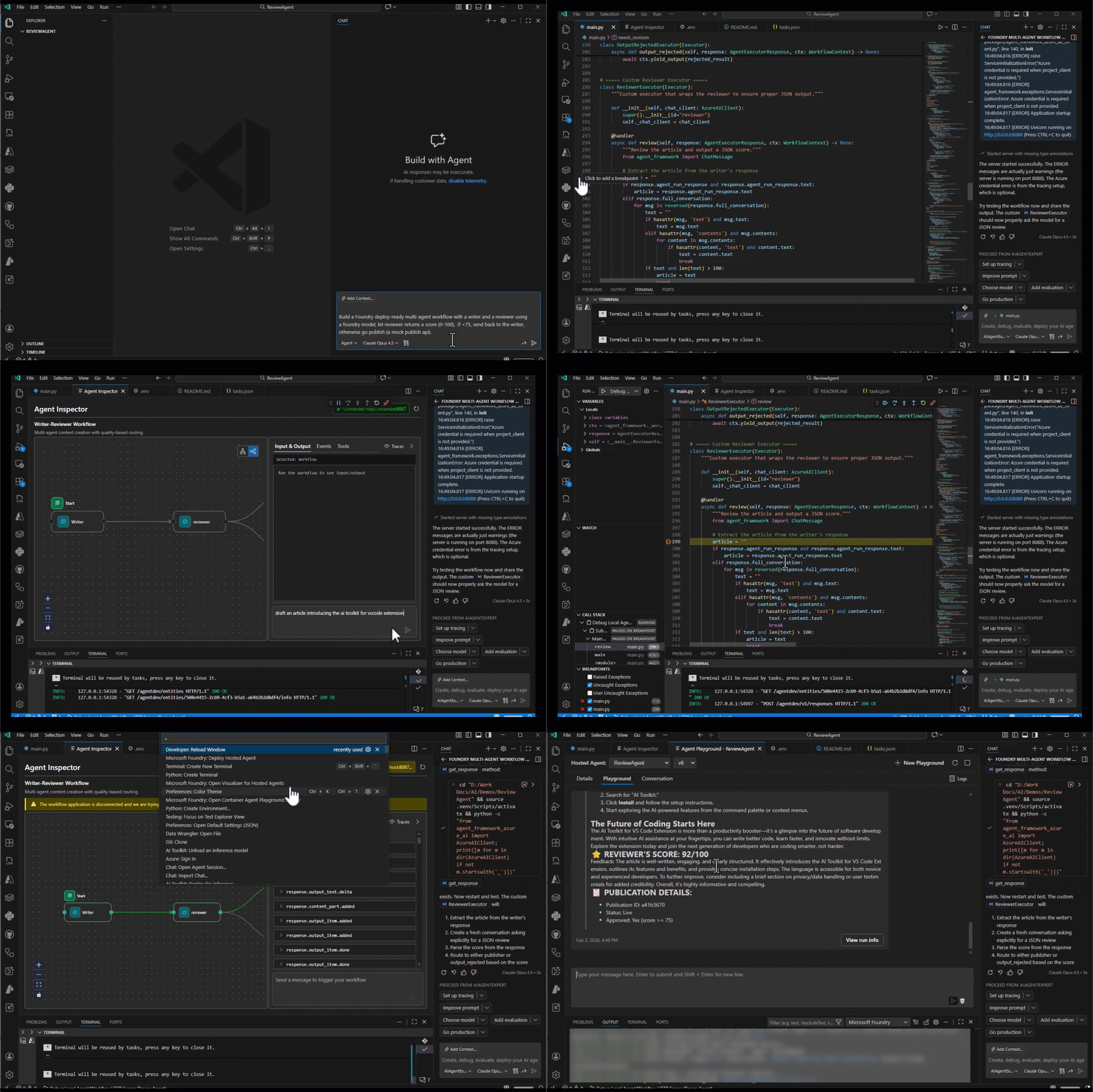
Alongside the runtime, the Foundry Toolkit for Visual Studio Code has reached general availability, and it closes the loop between writing an agent and shipping it. The toolkit lets developers scaffold agents from templates, integrate with GitHub Copilot, debug locally with trace visualization, connect to shared tools, and deploy directly to the Foundry Agent Service. Local debugging with trace visualization is the standout, because the hardest part of building agents is understanding why they did what they did across a long chain of tool calls and model decisions.
Observability has been the missing discipline in agent development, and this addresses it at the point of authoring rather than only in production. Being able to trace an agent's reasoning and tool use inside the editor, before it ever reaches a live environment, shortens the feedback loop that determines how fast a team can iterate. We have long argued that agents will only become dependable when developers can debug them with the same rigor they bring to ordinary software. Bringing trace visualization into the standard editor workflow is a concrete step toward treating agent behavior as something you inspect and fix, not something you hope works.
Memory, Tools, and Grounding
The release sits within a wider set of Foundry capabilities that together form a platform rather than a feature. Toolboxes provide a unified endpoint for tools, model context protocol clients, and enterprise data. Memory in the agent service adds procedural, user, and session memory, which Microsoft says improves task success rates by a meaningful margin. Foundry IQ handles enterprise knowledge grounding across multiple data sources, and a real-time voice interface is generally available for prompt-driven agents. Each of these answers a recurring question that surfaces the moment an agent moves from demo to deployment.
The pattern we see is Microsoft assembling the operational substrate that production agents require: durable memory so they can improve across sessions, governed access to tools and data so they act safely, and grounding so their outputs are tied to enterprise knowledge rather than to the open internet. None of these is glamorous, and none makes a good conference demo. But they are exactly the unglamorous concerns that decide whether an agent survives contact with a real enterprise. Building them into the platform, rather than leaving them to each team, is how agent adoption scales past the pilot stage.
A Platform Engineering Story, Not a Model Story
The most important thing about this release is what it is not about. It is not about a smarter model. It is about the platform engineering discipline required to run agents responsibly at scale: sandboxed isolation, dedicated resources, durable state, observability, memory, and governance. That reframing tracks the broader shift we have documented across the industry, where the differentiation in enterprise AI is moving from model capability toward the operational maturity of the systems that deploy it. The winners will be the organizations that can run agents safely, not merely the ones with access to the best models.
For platform engineering teams, the practical implication is that agents are becoming a first-class workload to be provisioned, isolated, and monitored like any other, and the tooling to do so is arriving. We would encourage those teams to evaluate hosted runtimes such as Foundry not on the novelty of the demo but on the questions that actually determine production readiness: how strong is the isolation, how observable is the behavior, how portable are the agents, and how governable is their access to data. Those are the criteria that will separate durable agent platforms from expensive experiments.