No blanket ban, five different answers
While New York City and Los Angeles reached for blanket restrictions this month, Massachusetts districts are taking a different approach, writing their own AI rules one district at a time. Reporting published September 22 by WBUR found Boston, Lexington, Medfield, Cambridge, and Hingham have each landed on a different policy, ranging from Boston's network-level block on ChatGPT paired with approval for Google Gemini, to Lexington permitting AI for tutoring and note organization while banning unverified AI facts in student reports. No single Massachusetts agency appears to be coordinating these decisions, and the state has not issued the kind of binding statewide framework that would force convergence.
Medfield restricts AI to early brainstorming and self-reflection, requiring teacher permission before a student can use it to develop an argument. Hingham takes a disclosure approach, requiring students to cite AI whenever it is used to generate ideas or edit work. Cambridge's rules track closely with Boston's. Each district arrived at its own answer independently, which means five districts in one state are now running five distinct compliance regimes for any vendor selling into them.
Boston backed its policy with a million dollars
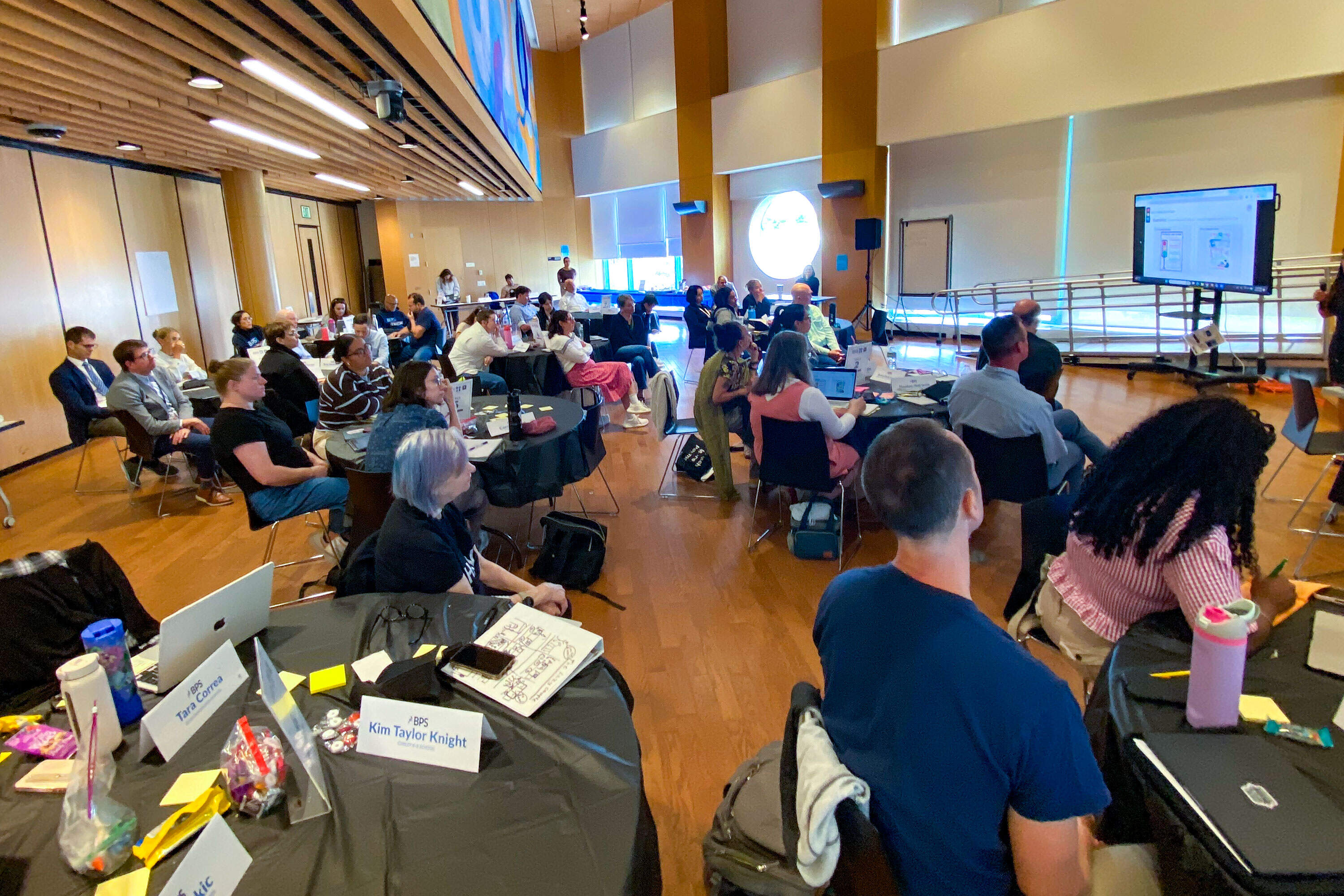
What separates Massachusetts's approach from simple inconsistency is that at least one district put real money behind it. Boston Public Schools launched a million dollar teacher training program alongside its network restrictions, an acknowledgment that a policy without training is just a rule nobody knows how to follow. Jeffrey Riley, executive director of Day of AI, framed the goal plainly: districts need to teach kids to be healthy skeptics of the technology, who mistrust and verify the information they get from it.
Medfield superintendent Jeff Marsden described a similar philosophy applied to staff, saying the district works in concert with staff and students rather than locking the technology down. Boston math teacher Kristina Danahy put the stakes in workforce terms, saying AI literacy has become critical for students rather than something a school can address by simply banning the tools. That approach is backed by actual training spend rather than a filtering rule alone, and it treats teachers as the delivery mechanism for the policy rather than as a compliance obstacle to route around with network-level blocks.
The usage data makes the case for urgency
The policy variation matters more because the underlying usage is already high and largely unsupervised. Common Sense Media found in March 2026 that nearly one in five kids between nine and seventeen use AI for schoolwork daily, a usage rate that predates most of the district policies now catching up to it. Half of students, per the same reporting, say their school has given them no instruction on how to verify whether an AI's output is accurate.
That gap, daily use without verification instruction, is the actual risk districts are managing. A policy that blocks ChatGPT but approves Gemini, as Boston's does, does not close that gap on its own, since a student who cannot verify an AI's output on ChatGPT will have the same problem on Gemini. It is the million dollar training investment sitting alongside the network rule that is meant to do that work, which is why we think the spending detail matters more than the specific tool restrictions, and why a district that copies Boston's blocklist without copying its training budget is copying the wrong half of the policy.
Fragmentation is a real cost, not just a footnote
For any vendor, system integrator, or shared-services provider working across multiple Massachusetts districts, and there are hundreds of districts in the state, five documented policies in one round of reporting signals far more variation underneath. A vendor's product approved in Lexington for tutoring use may be blocked outright in a neighboring district for the same use case, with no shared review process to appeal to and no state office coordinating the two decisions, which turns a single product pitch into dozens of separate district-by-district sales cycles.
We are sympathetic to the case for local control here. A single statewide policy risks getting the balance wrong for every district at once, while five districts experimenting in parallel generate five data points on what actually works in a classroom. That only pays off if someone is collecting those data points and sharing what works. Right now, each district appears to be running its own experiment with no visible mechanism for comparing results, which means the state risks paying the coordination cost of fragmentation without collecting the learning benefit that is supposed to justify it.
What this means for your roadmap
If your organization sells or deploys AI tools into K-12 or higher education, do not assume state-level uniformity is coming soon, in Massachusetts or anywhere else. Build your compliance and sales process around district-by-district variation as the default condition, and prioritize integrations that make it easy for a district's own IT and curriculum staff to configure restrictions locally rather than requiring a one-size answer that will inevitably clash with some neighboring district's rules.
For district and academic IT leaders watching this play out, the actionable takeaway is Boston's ratio: policy paired with funded training beats policy alone. A network restriction is cheap to write and easy to announce. A million dollar teacher training program is the harder, more expensive commitment, and it is the one more likely to actually change what happens in a classroom, which makes it the line item worth protecting the next time a budget cycle looks for something to cut.