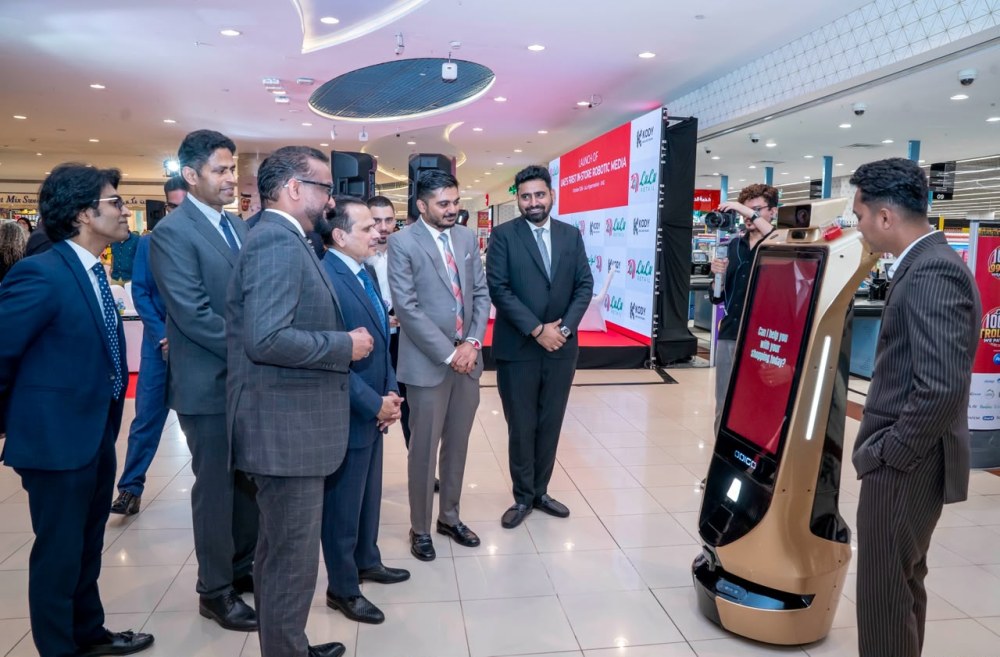
A service robot that doubles as a billboard
LuLu Retail has partnered with Kody Middle East Holding to deploy 62 AI-enabled Odigo robots across 30 stores in the UAE, and the framing from both companies makes clear this is not primarily a customer-service automation story. The robots do navigate store aisles to help shoppers locate products, a legitimate service function, but the companies are explicitly positioning the same hardware as an interactive advertising platform, showcasing brand promotions near the actual points of purchase where a shopper is standing when the ad appears.
That dual framing matters because it changes how the investment gets justified internally. A pure customer-service robot has to earn its budget against labor cost savings or a measurable lift in shopper satisfaction, a notoriously difficult thing to quantify cleanly. A retail media platform earns its budget against advertising revenue from CPG brands paying for placement, a far more direct and immediately measurable return, which is likely why LuLu and Kody chose to build and launch this as an advertising product from day one rather than retrofitting monetization onto an existing service-robot fleet later.
Why location-level targeting is the actual innovation here
Static in-store signage and shelf-edge displays have been sold as advertising inventory for years, but they share a fundamental limitation: once installed, the message does not change without physically swapping out the display, and it cannot be targeted any more precisely than the fixed location it occupies. LuLu's robotic network removes both constraints at once. Campaigns update in real time and can be customized by location, store, or market, meaning a CPG brand can run a different promotion in a store near a competitor's location than it runs in a store without that competitive pressure, something fixed signage has never been able to do economically at this kind of scale.
That flexibility is the part of this announcement that should interest retail media planners more than the robot novelty itself. Retail media has grown rapidly over the past several years specifically because it offers advertisers purchase-moment targeting that digital advertising elsewhere in the funnel cannot match, and a mobile, repositionable, real-time-updatable ad surface pushes that targeting precision further than fixed in-store media has previously been able to go, closing part of the gap between physical retail advertising and the granular targeting advertisers are used to getting online.
Scale from day one, not a cautious pilot
The deployment scale is the detail that separates this from a typical in-store technology trial. Rolling out 62 units across 30 stores in a single announced partnership, rather than placing two or three robots in a flagship location to generate press coverage and test the concept quietly, signals that LuLu and Kody believe the underlying unit economics already work well enough to commit at scale, not that they are still validating whether shoppers and brands will respond to the format at all.
That reading is reinforced by how specific the executive language is about measurability. Kody CEO Sanjay Kidecha described the platform as bringing advertising closer to the shopper by making it mobile, interactive, and measurable, language that targets a sophisticated retail media buyer's actual purchasing criteria, cost per impression and attribution confidence, rather than generic language about innovation or shopper experience that typically accompanies an unproven pilot still searching for its business case.
What this means for CPG media budgets
For CPG brands evaluating where to allocate retail media spend, this launch adds a genuinely new inventory category to the comparison set, not simply another retailer's version of an existing format. Brands already running retail media budgets across Walmart Connect, Amazon Ads, and similar platforms built around digital and on-site placements now have a physical, mobile, real-time-targetable in-store option to weigh against those established digital-first retail media platforms, with the specific appeal of placing the message at the exact moment and location a purchase decision is being made rather than earlier in the browsing journey.
The open question, and the one worth watching over the next several quarters, is whether LuLu publishes the attribution and performance data needed to let CPG brands actually compare this format's return against their existing retail media spend on a like-for-like basis. Retail media's entire pitch to advertisers rests on measurability, and a mobile advertising robot that cannot produce credible, auditable attribution data will struggle to pull meaningful budget away from platforms that already have years of comparable performance history behind them.
The broader pattern this fits into
LuLu's robotic rollout is one more entry in a broader 2026 pattern of retailers finding new physical surfaces to monetize as retail media inventory, turning fixtures and infrastructure that previously existed purely as cost centers, delivery fleets, shelf labels, now service robots, into advertising revenue lines. Each of these moves follows a similar logic: the retailer already owns and operates the physical infrastructure for an operational reason, and adding a monetization layer on top captures incremental revenue from hardware the business was committed to running anyway.
For retail technology leaders evaluating their own in-store automation investments, this pattern argues for building the monetization layer into the initial business case rather than treating it as a future upside to explore once the hardware is already deployed and running. A robot, a camera system, or a smart shelf justified purely on operational savings competes for budget against every other cost-reduction initiative in the business. The same hardware justified partly on advertising revenue potential from day one, the way LuLu and Kody have structured this launch, competes instead against the marketing budget, which is typically a larger and faster-growing pool of money in most retail organizations right now.