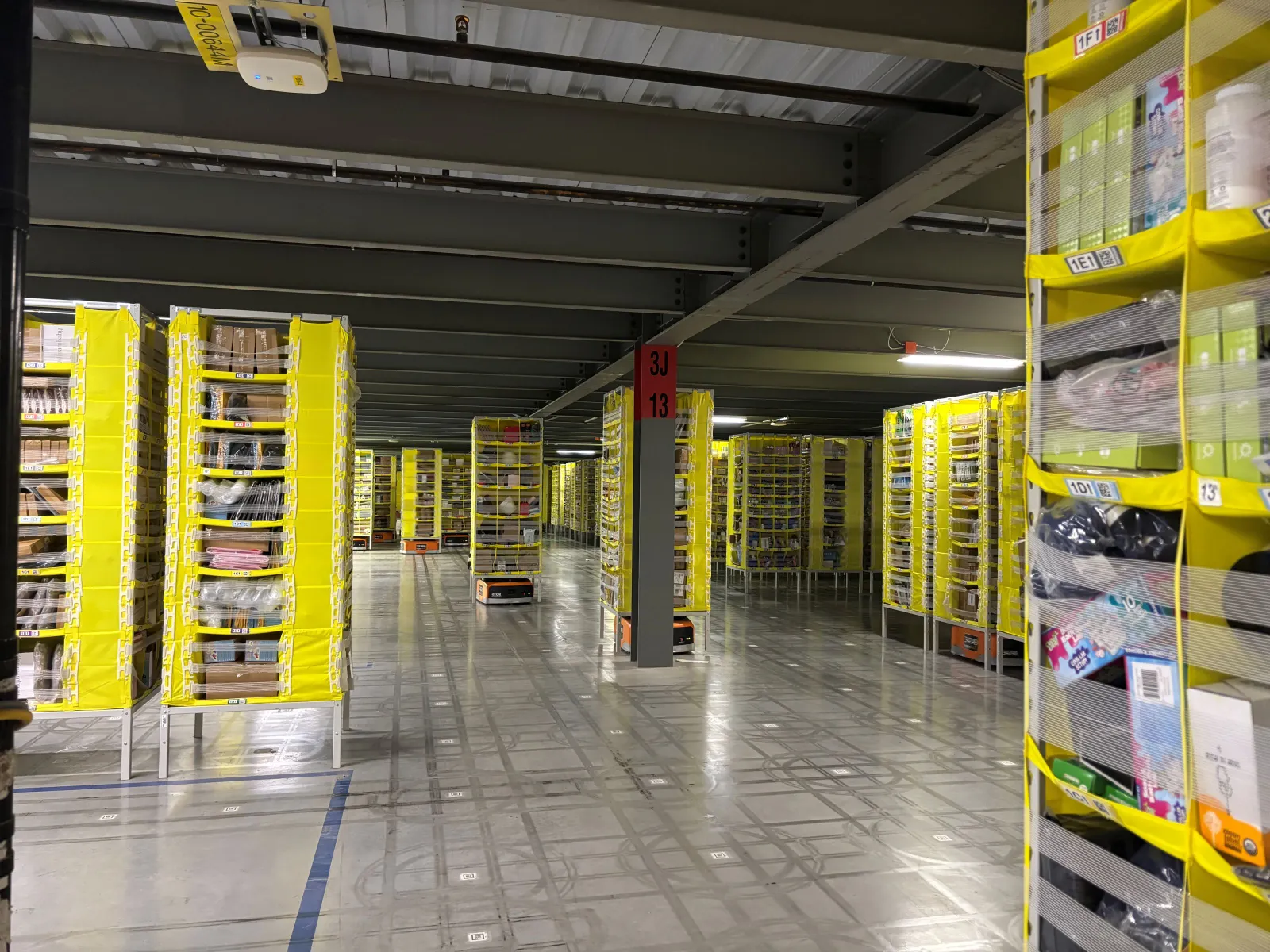
What a million parcels a day actually looks like
Amazon opened its BFI4 fulfillment center in Kent, Washington to public view this week, giving a look at what mature, high-throughput warehouse automation looks like once it is fully deployed rather than piloted. The facility, which opened in 2016, has become Amazon's first fulfillment center capable of processing more than 1 million parcels in a single day, a milestone that took roughly a decade of iterative automation investment to reach. That decade-long timeline is itself a useful data point for any executive being pitched a faster payback period by a warehouse robotics vendor today.
The workforce at the site remains substantial: approximately 3,500 associates work the facility, meaning the throughput gain has not come from removing people from the building but from changing what those people spend their time doing. That distinction matters for any retail operations leader modeling automation ROI against headcount, since the Amazon case reads as a productivity multiplier story more than a labor-reduction story at this stage of deployment, at least at the facility Amazon chose to showcase publicly.
Hercules robots and the inventory pod model
The core of the automation is Amazon's Hercules robot fleet, mobile units that transport four-floor shelving units, called pods, across the warehouse floor to stationary workstations rather than requiring workers to walk the aisles picking items by hand. The robots operate in a dedicated, fenced area separate from human work zones, a safety architecture choice that has become the standard pattern across the warehouse robotics industry rather than an Amazon-specific innovation, and one that most industrial robotics vendors now build into their systems by default.
What is notable is what the robots do not do: they do not pick items. That task still happens at semi-automated workstations, known internally as ARSAW, where human associates pull items from the pods a robot has just delivered, guided by projector lights that indicate exactly which item and bin to select. Amazon has had years to pursue fully autonomous picking and has not deployed it at this facility at scale, which is itself informative about where the technology's reliability ceiling currently sits for mixed, high-SKU inventory handled at real production volume rather than in a controlled demo environment.
The packing machine doing quieter, cheaper work
Less visible than the robots but arguably more directly tied to margin is the CW1000 packaging machine, which uses sensors to measure each item as it comes down the line and applies only the amount of wrapping material the item actually needs. That is a materials-cost and waste-reduction lever rather than a labor-automation one, and it is the kind of unglamorous efficiency gain that rarely makes headlines but compounds significantly at Amazon's shipping volume, where even a small per-package material saving multiplies into a large annual number.
The facility also runs manual packing stations equipped with automated tape dispensers and a separate area called the Amazon Fulfillment Engine for orders containing multiple items, which require different handling than single-item shipments. The layering of automated, semi-automated, and manual stations across a single facility gives a more realistic picture of enterprise warehouse automation than the fully autonomous, lights-out model often depicted in vendor marketing decks and industry conference keynotes.
What this means for retailers building their own automation roadmap
Amazon's scale gives it an automation budget most retailers cannot match, but the architecture choices at BFI4 are instructive regardless of scale. The decision to keep humans at the pick face rather than pursuing full robotic picking reflects a realistic assessment of where automation reliably beats human judgment, moving heavy pods long distances quickly and safely, and where it currently does not, distinguishing between visually similar SKUs, handling irregular or damaged items, and adapting to last-minute inventory changes on the fly.
Retail and logistics CIOs evaluating warehouse automation vendors should treat the human-robot division of labor at a facility like this as a benchmark for their own vendor conversations. A vendor pitching fully autonomous picking as production-ready today should be able to explain why Amazon, with a decade of iteration and effectively unlimited capital, has not deployed that model at its own highest-volume site, and what specifically their technology solves that Amazon's engineering organization has not.
The competitive pressure this creates
The throughput and efficiency gains visible at BFI4 are also a competitive signal to every retailer running its own fulfillment network. A facility processing over 1 million parcels daily with a workforce of 3,500 sets a productivity benchmark that ripples into delivery speed commitments and cost-per-shipment economics across the industry, and competitors sizing their own automation investment against Amazon's public numbers now have a harder target to hit when they present their own roadmap to the board.
Few retailers will ever operate at Amazon's volume, so the more useful takeaway for most retail technology leaders is the sequencing Amazon chose: robotics for movement first, materials efficiency second, and full autonomous picking deferred until the technology earns its place on the floor. That is a more conservative and more defensible automation roadmap than the leapfrog approach some retailers are being sold by robotics vendors eager to skip straight to lights-out fulfillment before the underlying picking technology has proven itself at comparable scale. A phased sequence also gives operations teams time to build the safety, maintenance, and exception-handling processes that automation depends on, rather than discovering the gaps after a full site conversion.