Agentic AI Aimed at the Back Office
On July 13, Fujitsu disclosed a field trial of an AI agent developed jointly with AEON Food Style, one of the retail arms inside Japan's AEON group. The trial runs this July at a physical store, and its target is unusual for retail AI. Most recent launches point agents at shoppers, powering conversational search and cart building. This one points at the store manager, taking on the planning and merchandising work that consumes management time and varies widely from store to store.
We find the framing instructive. AEON Food Style was formed by integrating operations across several banners, and integration creates exactly the problem agents are good at: inconsistent processes that need to be captured, codified, and standardized. Rather than automate the checkout, Fujitsu is automating the judgment work behind assortment and layout, where experienced managers still lean on intuition and where headquarters struggles to enforce a common playbook across a large footprint.
Two Jobs: Strategy and Shelves
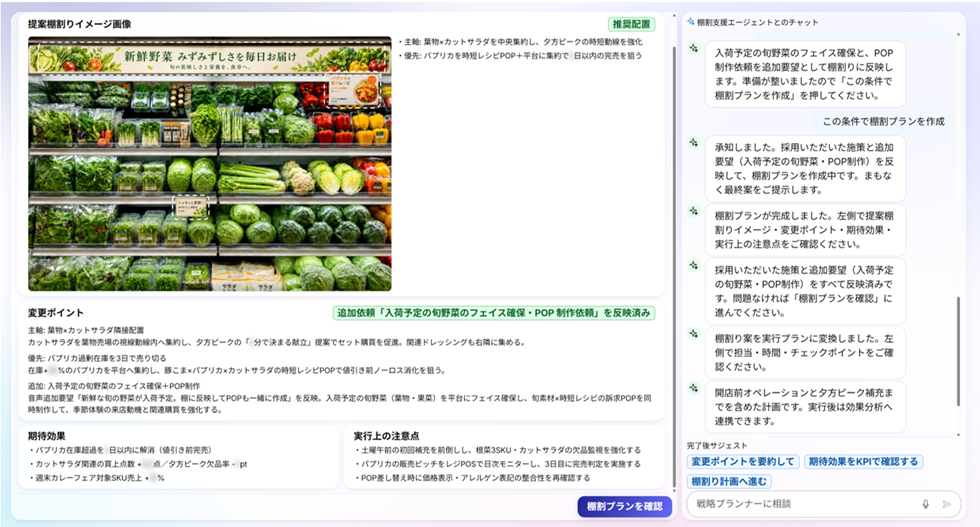
The agent handles two applications. First, store strategy formulation: it analyzes a location using the 3C framework of company, customer, and competitor, then drafts medium-to-long-term strategies for that store. Second, shelf layout planning: it generates detailed shelf plans and layout images based on headquarters instructions, product data, and the individual characteristics of each store. Both outputs feed directly into work that managers otherwise assemble by hand from spreadsheets, planograms, and experience.
What makes this more than a document generator is the chain from analysis to artifact. The system does not stop at a recommendation. It produces the layout image and the plan a manager can act on, which is where retail AI projects usually stall. We have seen plenty of tools that surface insight and leave the operator to translate it. Closing that last gap, from strategic reasoning to an implementable shelf, is the part worth watching in the trial results.
Ten Days, Four Prototypes
The build method is the story for anyone running an AI program. Fujitsu deployed forward-deployed engineers who created four AI prototypes in approximately ten days. They did it by first identifying common operational tasks across the three integrated companies inside AEON Food Style: MaxValu Kanto, Daiei's Kanto operations, and AEON Market. The task inventory came before the model work, which is why a small team could move from problem to prototype in days rather than quarters.
This mirrors a pattern we have flagged before across the enterprise. The bottleneck in agentic deployments is rarely the model. It is understanding the actual work, decomposing it into steps an agent can execute, and defining what a good output looks like. Fujitsu's forward-deployed engineering approach front-loads that discovery inside the customer's operation, and the ten-day figure is a credibility marker that the discovery was scoped tightly rather than boiled into a year-long transformation program.
Measuring Whether It Actually Works
The trial is instrumented around outcomes, not novelty. Fujitsu says it will verify effectiveness through time reduction in strategy formulation tasks, the adoption rate of AI-generated plans, and efficiency gains across the shelf planning-to-implementation workflow. It also targets standardization of operations across store locations, which is the strategic reason a multi-banner group would fund this in the first place.
Adoption rate is the metric we would watch hardest. Time saved is easy to claim and easy to game. Whether managers actually accept the AI's strategy and shelf plans, and implement them without heavy rework, is the honest test of whether the agent earned trust on the floor. A high adoption rate would suggest the outputs are good enough to change behavior. A low one would expose the familiar gap between a plausible plan and one a seasoned operator will stake a quarter on.
From Single Agent to Multi-Agent Retail
Fujitsu positions this as an early step, not an endpoint. The company plans to expand the agent's capabilities toward sales-growth applications and to develop multi-agent systems under its Uvance for Retail initiative. The direction implies a store run by a set of cooperating agents, each owning a slice of operations, coordinating toward assortment, speed, and margin goals set by headquarters.
We would temper the ambition with a practical note. Multi-agent systems multiply the surface area for error, and retail operations are unforgiving when a plan hits the shelf wrong. The disciplined path is to prove the single-agent case in this trial, establish that managers adopt its output, and only then let agents hand work to one another. AEON's scale gives Fujitsu a demanding proving ground, and the integrated-banner context gives it a standardization payoff that justifies the investment if the trial holds up.
Why It Matters Beyond Japan
For retail CIOs elsewhere, the interesting export is the pattern rather than the product. A large grocer with recently merged operations used forward-deployed engineers to turn undocumented managerial judgment into agent-executable tasks, then measured adoption on the floor. That recipe travels. Any multi-banner retailer carrying inconsistent merchandising processes after acquisitions has the same latent opportunity and the same standardization prize.
The broader signal is where agentic value is accruing in retail. The consumer-facing agents get the headlines, and they matter. The quieter gains may come from the manager's desk, where strategy and planograms still absorb enormous time and resist consistency. Fujitsu and AEON Food Style are testing whether an agent can carry that load. If the adoption numbers land, expect this back-office framing to spread faster than the storefront chatbots that currently dominate the conversation.