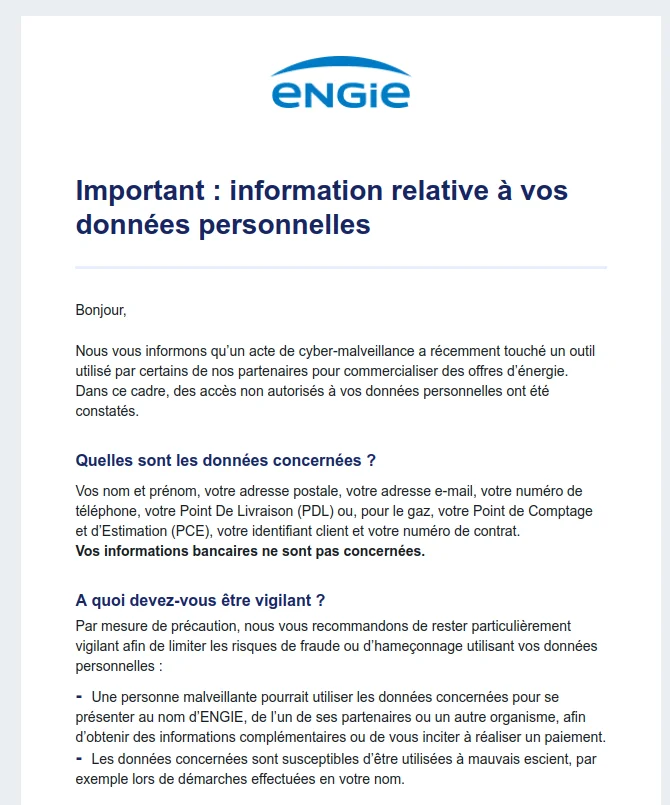
What ENGIE told customers
ENGIE notified customers in France that attackers had gained unauthorized access to their personal data through a sales tool used by some of its business partners to market electricity and natural gas offers. The company's notification described the incident as "an act of cyber-malice" affecting a tool used by its partners, and separately confirmed that "unauthorized access to your personal data was identified." ENGIE was explicit that its own internal IT systems were not compromised, framing this as a partner-side incident rather than a breach of its core infrastructure.
That distinction is true and also somewhat beside the point for the customers affected. From a customer's perspective, data tied to their ENGIE account was exposed regardless of which system, ENGIE's or a partner's, actually failed. The company says it blocked the attackers' access once discovered, notified relevant authorities, and reached out directly to affected customers, but it has not disclosed how many customers were affected, how the intrusion began, or how long attackers had access before detection.
What was actually exposed
The confirmed scope covers names, postal addresses, email addresses, and phone numbers, along with customer IDs and contract numbers. It also includes energy-specific identifiers: the delivery point identifier, or PDL, for electricity customers, and the metering and estimation point, or PCE, for gas customers. ENGIE says banking information and other financial data were not affected, and its investigation indicates the exposure was limited to contact details and certain contract information rather than anything more sensitive.
PDL and PCE identifiers are narrow in isolation, but combined with a customer's name, address, and contract number, they give a convincing basis for impersonation. A caller who can recite your correct delivery point identifier and contract number sounds legitimate even if they are not from ENGIE at all. The company's own guidance to customers reflects this: verify unexpected requests through official channels, navigate to ENGIE's site or app directly rather than through email links, and never share SMS codes, passwords, or banking details with unsolicited contacts.
The attacker, the platform, and what remains unnamed
ENGIE has not attributed the attack to any specific group, and as of this writing no ransomware operation has claimed responsibility, which leaves the incident in an unusual state: confirmed and disclosed, but with no public accounting of who did it or how. The company has also declined to name the partner or the specific platform involved, which means ENGIE customers, and anyone trying to learn from this incident, cannot independently assess how the tool was compromised or whether other energy providers use the same platform.
That kind of opacity shows up routinely in early breach disclosures across the industry, which makes ENGIE's silence on these specifics unremarkable on its own. It matters more here because the vulnerability sits in shared partner infrastructure rather than a single company's systems. The energy retail sector in particular tends to concentrate around a small number of sales and CRM vendors that serve many providers at once, which means a flaw in one widely used platform can touch customers of several unrelated utilities simultaneously. If the compromised sales tool is used elsewhere in that partner ecosystem, the exposure may extend well beyond ENGIE's own customer base, and neither ENGIE's customers nor the public will know that until, and unless, someone discloses it.
Why this is a governance failure, not a technology one
ENGIE's core IT environment, the systems a security audit would typically scrutinize most closely, held up throughout this incident. The failure happened in a category that audits frequently underweight: third-party sales and marketing tools that partners use to interact with a company's own customer base on its behalf. Access into these tools tends to get scoped generously at onboarding, because the sales relationship is the priority at that moment, and revisiting that scope later competes poorly against whatever the sales team is asking for next.
This pattern repeats across every industry that relies heavily on partner and franchise networks to reach customers: energy retail, insurance, telecom, and increasingly retail commerce platforms that let third-party sellers or affiliates touch customer data directly through shared portals. The common root cause across all of them is treating partner tool access as a one-time onboarding decision rather than an ongoing relationship that needs the same monitoring, least-privilege review, and offboarding discipline a security team would insist on for its own employees' access.
The regulatory clock is already running
ENGIE operates under France's data protection regime, which gives it a short, defined window to notify France's data protection authority once a personal data breach is confirmed, separate from the customer notifications it has already issued. That timeline exists precisely because incidents like this one tend to unfold in partial disclosures, a notification to customers first, a fuller account to regulators later, and sometimes a more complete picture only after a regulatory investigation forces one, which is the pattern so far here as well.
For any company operating in the European Union, the ENGIE incident is a reminder that a breach originating in a partner's systems does not relieve the data controller of its own regulatory notification duties. ENGIE remains the controller of the customer data in question regardless of which system leaked it, and regulators will evaluate ENGIE's vendor oversight, not just the partner's security, when assessing whether the company met its obligations under the circumstances.
The decision CIOs should take from this
Build an actual inventory of every partner-facing tool that can read or write your customer data, not just the ones security remembers approving, because sales and marketing organizations frequently onboard new partner platforms faster than any security review cycle can track them, and the first time security hears about a tool is sometimes during an incident like this one. For each tool on that list, document what customer data it can reach, which external organizations and individuals hold credentials into it, and when those credentials and that scope were last reviewed rather than simply renewed on autopilot.
Then apply the same incident-response assumptions to partner tools that you apply to your own production systems: assume eventual compromise, scope access to the minimum the partner actually needs, and build detection for anomalous data access patterns coming through partner integrations specifically. ENGIE's internal systems being clean did not protect a single customer whose data moved through the compromised partner tool, and that is the lesson worth carrying into your own vendor risk review this quarter, not a comforting footnote about whose fault it technically was.