A beat built on both ends of the business
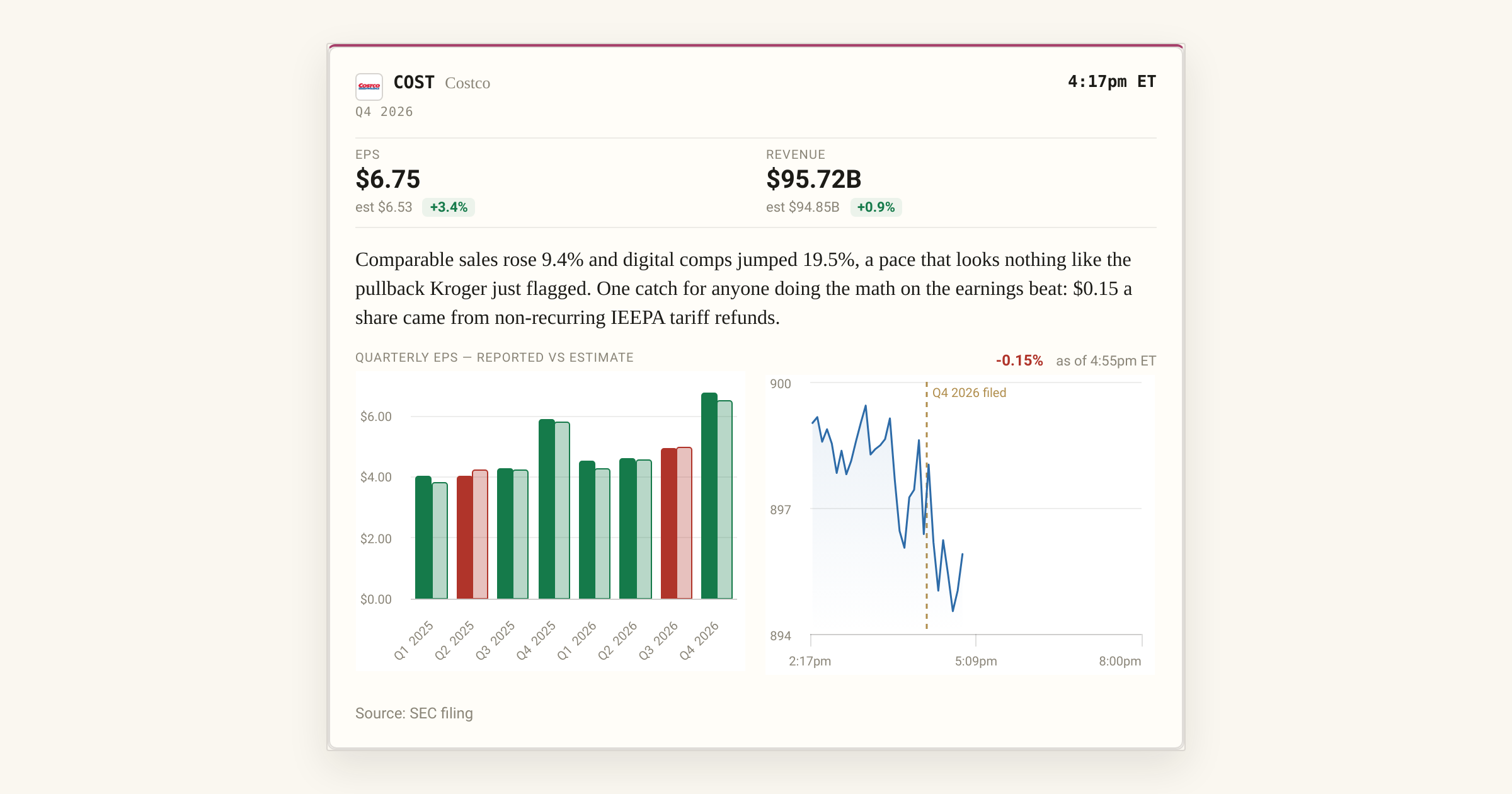
Costco's fiscal fourth quarter results landed comfortably ahead of expectations on every major metric: revenue of 95.72 billion dollars beat estimates by just under 1 percent while growing 11.1 percent year over year, and earnings per share of 6.75 dollars beat consensus by 3.4 percent. Full fiscal year 2026 revenue reached 303.15 billion dollars, up 10.1 percent, showing the strong quarter capped a full year of sustained growth rather than a single standout period.
Operating income grew 12.5 percent to 11.69 billion dollars and free cash flow expanded nearly 20 percent to 9.39 billion dollars, giving Costco substantial capital flexibility heading into its next fiscal year. Worth noting for anyone modeling forward quarters: 15 cents per share of the EPS beat came from non-recurring IEEPA tariff refunds, a detail that slightly overstates the underlying operating beat relative to the headline number.
The digital number that stands out against the sector
Comparable sales grew 9.4 percent with comparable traffic up 3.3 percent, solid but not extraordinary figures for a warehouse retailer of Costco's scale. The standout number is digital comps, which jumped 19.5 percent, more than double the overall comp sales growth rate and a pace that diverges sharply from broader grocery sector trends this quarter, including a pullback Kroger flagged in its own recent reporting.
That divergence matters because grocery e-commerce has historically been a difficult margin category across the industry, with delivery costs and lower basket sizes squeezing profitability even as digital order volume grows. Costco converting membership loyalty into digital growth at nearly triple the rate of overall comp sales suggests the company's membership model, where customers have already paid an annual fee and are incentivized to concentrate spending with Costco specifically, may provide a structural advantage in digital adoption that grocery competitors without a similar membership base cannot easily replicate.
DoorDash as the growth lever nobody expected from Costco
The nationwide expansion of Costco's DoorDash partnership is cited directly as a contributor to the digital comp growth, a notable strategic choice for a company whose business model has historically centered on driving members physically into warehouses to maximize both basket size and the in-store browsing that drives impulse purchases beyond a shopper's original list. Delivery partnerships work against some of that dynamic by design, trading incremental impulse purchase potential for pure convenience and incremental order volume from members who would not otherwise make the trip.
That Costco is willing to make this trade at meaningful scale suggests the company has concluded that capturing digital order volume, even at some cost to the in-store impulse dynamic that has long differentiated its model, is now a higher priority than protecting that traditional advantage unchanged. It's a bet that the incremental digital reach outweighs whatever basket-size dilution comes with shifting some purchases away from the physical warehouse experience.
The membership engine still doing the heavy lifting
Costco's core membership economics remain exceptionally strong: 150.4 million total cardholders, an 89.8 percent worldwide renewal rate, and membership fee income growing 7.3 percent to 1.85 billion dollars. Those numbers matter more to Costco's business model than they would for a typical retailer, since membership fees flow almost directly to operating profit and function as a recurring revenue stream largely independent of retail sales volume in any given quarter.
Executive memberships, Costco's higher-tier paid option offering enhanced rewards, now account for 75.6 percent of sales, a striking concentration that shows the company's most committed, fee-paying members are disproportionately responsible for actual purchase volume as well. That correlation between membership tier and spending gives Costco a clear, data-backed lever for future growth: continuing to convert standard members to executive tier compounds both fee revenue and retail sales simultaneously.
Physical expansion continues alongside digital investment
Costco is not treating digital growth as a replacement for physical expansion. The company plans roughly 28 net new warehouses in fiscal 2027, targeting approximately 967 total locations worldwide, a expansion pace consistent with recent years despite the accelerating digital comp growth. That dual investment, continuing to open new physical warehouses while simultaneously scaling delivery partnerships and e-commerce traffic, reflects confidence that the two channels are complementary rather than substitutive for Costco's specific model.
E-commerce site and app traffic grew 30 percent for the quarter, reinforcing that the digital growth story extends beyond the DoorDash partnership specifically into Costco's own direct digital channels as well. For a company whose core identity has been built around the physical warehouse shopping experience for decades, sustaining growth across both physical and digital channels simultaneously, rather than one cannibalizing the other, is the more difficult and more valuable outcome to achieve.
What this means for the rest of grocery and warehouse retail
Costco's results land as a useful benchmark precisely because they diverge from the softer signals coming out of Kroger and other grocery competitors this quarter. If Costco's membership-driven loyalty is genuinely providing a structural digital advantage that non-membership grocery models cannot replicate, that has real implications for how other grocery and warehouse retailers should think about loyalty program design, not as a marketing add-on but as core digital growth infrastructure.
For technology and operations leaders at competing retailers, the practical question this quarter raises is whether membership or loyalty program depth, not just delivery partnership breadth, is the more durable lever for digital growth going forward. Costco's numbers suggest the answer may increasingly be yes, which would argue for prioritizing loyalty program investment over pure logistics and delivery partnership expansion for retailers without Costco's existing membership base to build on.