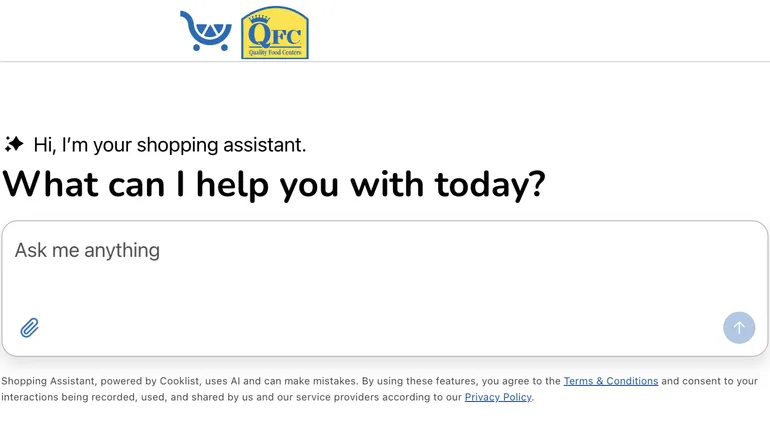
The Search Box Gives Way To A Conversation
Grocery e-commerce has quietly reached its agentic moment, and Cooklist is one of the clearest examples of what that looks like in practice. Rather than typing a product name into a search box and assembling a cart item by item, shoppers describe what they need in plain language, and an AI assistant builds the basket for them. Cooklist describes its technology as combining the capabilities of a personal shopper, a chef, and a nutritionist, which is a useful way to understand the shift. The interaction is no longer a lookup. It is a delegation, where the shopper states an intent and the system does the assembling.
The behavioral data behind the shift is telling. Cooklist co-founder Brandon Warman noted that the average chat message runs about 50 characters, versus roughly 10 characters for a typical search query, and drew the obvious conclusion: "We're getting about five times more context with each message from a user." That extra context is the whole game. A search for "chicken" tells a retailer almost nothing, while a sentence describing a week of family dinners with a nut allergy and a tight budget tells it almost everything. The conversational interface is not just friendlier, it is a richer stream of intent that traditional grocery e-commerce never captured.
Real Scale, Not A Pilot
What separates this from the endless parade of retail AI demos is that it is already deployed at meaningful scale. Cooklist's assistant is live at seven grocers spanning more than 700 US stores, and the roster is not a list of experimental boutiques. It includes major Kroger banners, Fred Meyer, Ralphs, Baker's, Dillons, QFC and Smith's, alongside Wegmans, a chain with a near-devotional customer base. The company expects to reach roughly 700 additional locations within weeks, and says it can integrate its technology into a retailer's e-commerce platform in about six weeks. That is production, not proof of concept.
The integration speed matters as much as the store count. A six-week deployment window means a regional grocer can go from evaluation to live agentic shopping inside a single quarter, without a multi-year platform overhaul. For an industry defined by thin margins and long technology cycles, that changes the calculus of adoption. Retailers that once treated conversational commerce as a distant experiment can now treat it as a near-term operational decision. The fast integration is also a competitive accelerant, because it lets the technology spread across the fragmented grocery landscape far quicker than the heavy, bespoke builds that characterized earlier waves of retail digitization.
The Real Fight Is Over Data Ownership
The most strategically important detail is easy to overlook because it is not about the AI at all. It is about who keeps the data. Cooklist's pitch to retailers is that they retain complete ownership and control of their customer data, avoiding dependence on third-party providers like Instacart. In the grocery business, that distinction is existential. When a retailer routes its shoppers through an intermediary's marketplace, it gradually cedes the customer relationship, the purchase history, and the advertising leverage that come with it, becoming a fulfillment engine for someone else's platform.
We have watched this dynamic play out across retail for a decade, and grocers have learned the lesson expensively. The value in agentic shopping is not only the convenience delivered to the customer, it is the intent data generated by the interaction, which powers personalization, merchandising and retail media. A model where the grocer owns that data outright is a direct rejection of the arrangement in which a platform owns the discovery layer while the retailer merely supplies goods. Cooklist is selling grocers a way to get agentic capability without surrendering the asset that agentic capability is most valuable for producing.
Digital Discovery, Physical Basket
One of the more counterintuitive findings in Cooklist's data is where these journeys end. Roughly 50 percent of shoppers who use the assistant go on to visit a physical store to complete their purchase. That single statistic dismantles the tidy assumption that conversational commerce is purely an online funnel that terminates in home delivery. Instead, the assistant is functioning as a planning and discovery tool that shapes a shopping trip which then happens in the aisle. The AI builds the mental cart, and the customer builds the real one on the way home from work.
For grocers, that hybrid pattern is strategically reassuring and operationally demanding at once. It means the significant investment many chains have made in physical stores is not being cannibalized by AI-driven online shopping, but rather fed by it, as digital planning drives store visits. It also means the assistant has to reflect real, local, in-store availability to be trustworthy, because a shopper who drives to the store expecting the items the AI suggested will not forgive an empty shelf. Bridging the online recommendation and the physical inventory is the unglamorous integration work that determines whether the experience delights or disappoints.
What Retail Leaders Should Take Away
For retail technology leaders, Cooklist is less interesting as a product than as a template for a strategic choice. The industry is being pushed toward agentic shopping by the large platforms, and the tempting path is to plug into whichever intermediary offers the fastest reach. The harder but more durable path is to adopt agentic capability while keeping ownership of the customer relationship and the intent data it generates. Kroger and Wegmans are, in effect, voting for the second path, betting that owning their shopper data is worth more than the convenience of outsourcing the interface.
The broader lesson extends well beyond grocery. As AI agents insert themselves between customers and retailers across every category, the defining question for merchants is whether they will own the layer where intent is expressed or rent it from a platform. The retailers that treat conversational interfaces as their own strategic infrastructure, integrated with their inventory and feeding their own data assets, will preserve the leverage that makes retail a business rather than a fulfillment contract. Those that hand the interface to a third party for a quick win may find, as many did in the marketplace era, that convenience today becomes dependence tomorrow.


