Frontier Models Meet the Azure Control Plane
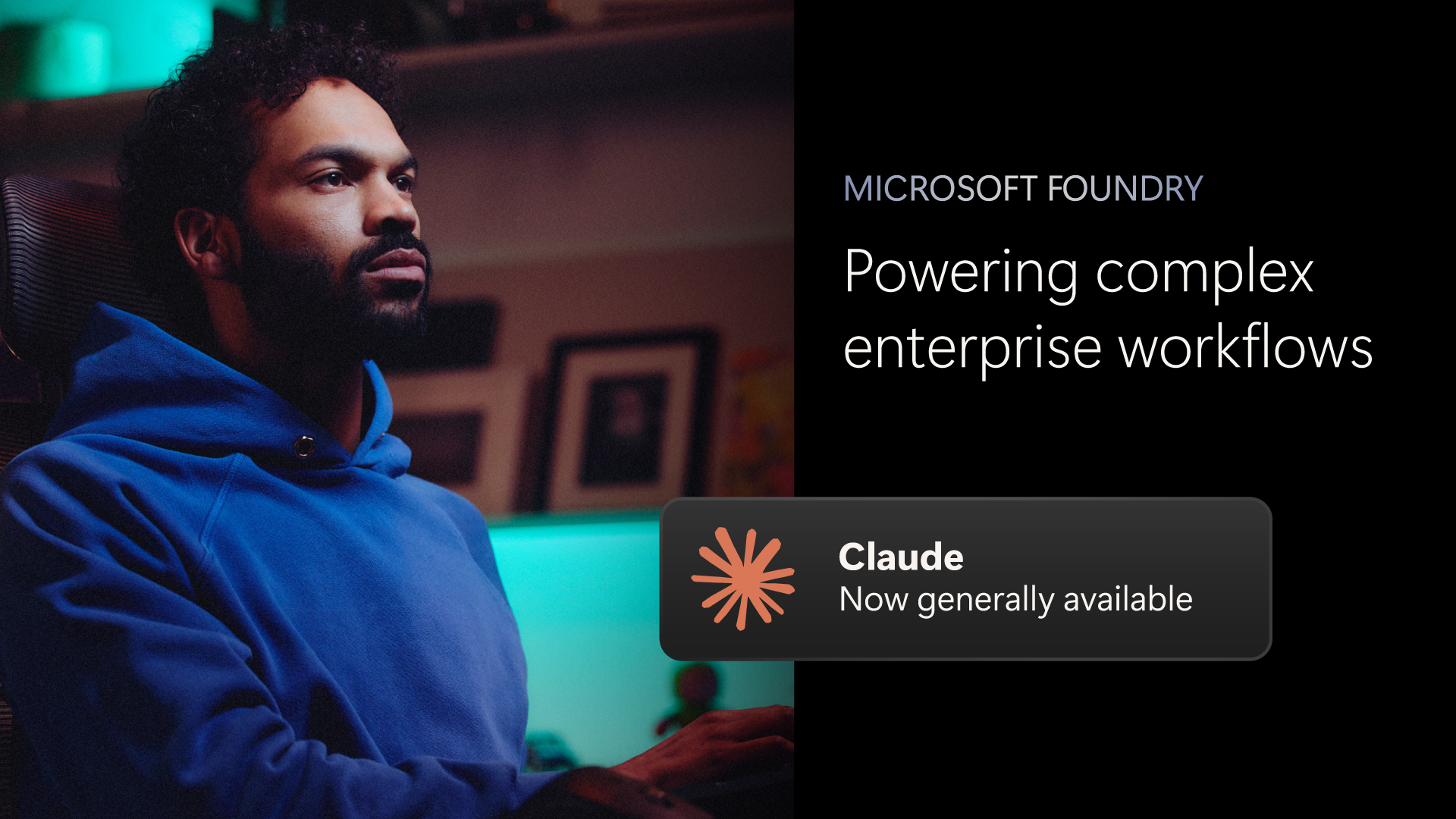
Microsoft has moved Anthropic's Claude models into general availability on Microsoft Foundry, and the significance is less about the model than the plumbing. Enterprises have wanted frontier-class models available with the same governance, identity and procurement machinery they already use, rather than as a separate vendor relationship bolted onto the side. General availability in Foundry delivers exactly that. As Steve Sweetman, Azure product lead, put it, Claude in Microsoft Foundry is the production path enterprises have been asking for: true frontier model choice, Azure-native controls, simplified procurement, and faster time to value.
The framing matters because model access is no longer the differentiator. Governance is. A capable model that cannot satisfy an enterprise's data residency, identity and audit requirements is unusable in regulated settings regardless of its benchmark scores. By bringing Claude inside the Azure control plane, Microsoft is competing on the operational layer that actually gates deployment. For CIOs, the calculus shifts from which model is best in the abstract to which model can be run safely under the controls their industry demands.
The Hardware Underneath
The infrastructure story is the headline for anyone building at scale. Claude runs on NVIDIA's liquid-cooled GB300 NVL72 Blackwell Ultra architecture connected by Quantum-X800 InfiniBand networking. The GB300 is a dual-die accelerator offering 192 GB of HBM3e memory per GPU and a 1.8 TB per second NVLink fabric that scales to 72-GPU NVLink domains inside a single rack. That density is what makes serving large models with long context economically viable, and it is why the hyperscalers are racing to deploy Blackwell Ultra capacity.
The performance delta is concrete. According to Microsoft, a 32-PTU deployment of Claude Sonnet on GB300 delivers roughly 40 percent higher throughput at the same latency budget compared with the previous H200-based incarnation. For enterprises, throughput at a fixed latency is the metric that translates directly into cost per token and user experience. A 40 percent improvement is the difference between an agentic workload that is affordable at scale and one that is not, and it explains why hardware generation, not just model choice, now drives cloud AI economics.
Governance Built for Regulated Buyers
The enterprise feature set is where this release earns its production label. Foundry offers data residency options across Global and US data zones, zero data retention for sensitive workloads, Microsoft Entra ID authentication and Azure role-based access controls. Billing runs through Claude Consumption Units that appear directly on the Azure bill. Each of these addresses a specific objection that has kept frontier models out of regulated environments, from where data lives to who can invoke a model to how the spend is tracked and governed.
Zero data retention deserves particular emphasis. For financial services, healthcare and government buyers, the guarantee that prompts and outputs are not retained is often a precondition for any deployment at all. Pairing that with region-locked inference and native identity integration gives compliance teams a defensible story to tell auditors. Gary Ballabio, a VP at Bolt, spoke to the reliability dimension, noting that running Anthropic's models on Azure has given us the sustained throughput and reliability our enterprise customers expect. That combination of governance and stability is the product.
The Multi-Model Hyperscaler Race
This launch sharpens a competition that is reshaping the cloud business. The hyperscalers are converging on a multi-model strategy in which the platform, not any single model, is the moat. Microsoft hosting Claude alongside its OpenAI relationship signals that customers want optionality, and that the cloud provider who offers the broadest set of governed frontier models on the best hardware wins the workload. Model exclusivity is giving way to model marketplace, with the control plane as the point of lock-in.
For AWS, Google Cloud and Microsoft, the strategic logic is the same: capture the AI workload by being the place where any capable model can be run under enterprise controls on state-of-the-art silicon. Anthropic benefits from distribution across multiple clouds, and enterprises benefit from not having to choose a single provider to access a given model. The result is an arms race in Blackwell Ultra capacity, InfiniBand fabric and governance features, and this Foundry release is a clear marker of where that race now stands.
What It Means for Enterprise Buyers
For technology leaders, the practical upshot is that frontier model access is becoming a procurement decision rather than a research project. If your organization already runs on Azure, adding Claude now looks like adding a service, not onboarding a new vendor. That lowers the friction of experimentation and, more importantly, of moving from pilot to production. The governance controls that gated regulated deployment are increasingly available out of the box, which shifts the bottleneck from platform readiness to internal use case discipline.
The caution is the familiar one. Easy access to a powerful model does not produce value on its own, and the falling friction can encourage sprawl. The organizations that benefit will be those that pair this newfound availability with clear governance over which use cases justify the spend and how outputs are validated. The hardware and the control plane are ready. Whether enterprises convert that readiness into measurable outcomes remains, as always, a question of discipline rather than technology.