Two services, two completely different customers
B&Q announced two separate delivery expansions in the same week, and the split between them is the more interesting story than either announcement alone. The consumer-facing piece widens an existing Deliveroo partnership, following a trial, to more than 100 stores nationwide, covering more than 9,000 home improvement products. Deliveroo's own VP of consumer, Suzy McClintock, put the delivery window at as little as 25 minutes for items ranging from paint to power tools, while B&Q's own announcement describes the window as 35 minutes, a discrepancy that itself hints at how aggressively each side is marketing the same underlying service.
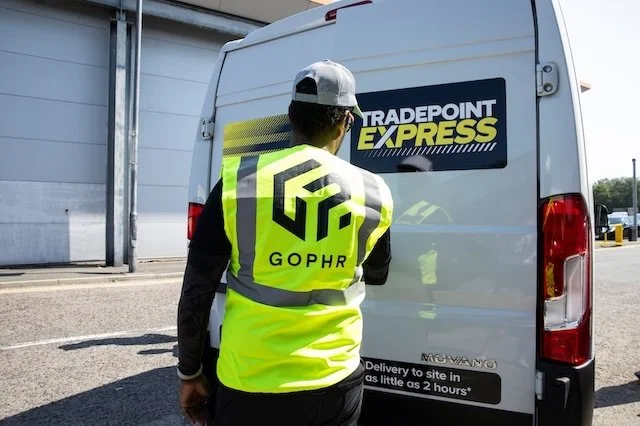
The second piece, TradePoint Express, is built for a completely different customer with completely different expectations. It offers trade account holders same-day delivery either within a two-hour window from the time of booking or through a pre-booked two-hour same-day slot, arranged directly through a Business Development Manager rather than a self-serve app flow. It launched from the standalone TradePoint store in Barking and is now live at 123 participating B&Q stores, with plans to expand to the rest of the TradePoint network later this year, building on an earlier Marketplace Click and Collect launch.
Why a single retailer needs two logistics stacks
Consumer quick commerce and trade fulfillment are not the same problem wearing different branding. A consumer ordering paint for a Saturday project cares about speed and impulse convenience and is tolerant of a third-party courier app handling the last mile, which is exactly what Deliveroo's existing restaurant and grocery delivery infrastructure is built for. A trade professional ordering materials for a job site cares about reliability, volume, and a direct line to a human who understands their account and project timeline, which is a relationship-driven service that a generic consumer delivery app is not designed to replicate.
John Morgan, B&Q's director of TradePoint, made that distinction explicit, saying time is one of the most valuable resources for trade professionals and framing the service as reducing time spent collecting materials rather than as a speed competition. Gophr's commercial director Graham Smith echoed that framing, pointing to the courier network's technology and delivery infrastructure as enabling flexible, same-day fulfillment specifically for busy professionals rather than impulse consumers. Running both models well means B&Q's technology team has to support two integration patterns, two SLA structures, and two sets of customer service expectations simultaneously.
The quotes reveal an ongoing strategy, not a one-off launch
B&Q's supply and logistics director, Amelie Gallichan Todd, described the moves as continually evolving the ways customers can shop with the company, language that signals this is one step in a longer sequence rather than a finished strategy. That framing matters for how competitors and partners should read the announcement: B&Q is positioning itself to keep adding delivery partners and formats as it finds gaps, rather than committing to a single logistics architecture it expects to hold for several years.
That posture carries real technical debt risk if it is not managed deliberately. Every new delivery partner integration, whether Deliveroo's consumer-facing API or Gophr's trade-focused booking flow, adds a dependency that has to be maintained, monitored, and eventually migrated if the commercial terms shift or the partner's service quality slips during a peak period. A retailer that treats each new partnership as a one-off integration rather than a modular capability ends up with a tangle of point-to-point connections that becomes progressively harder to simplify.
What this signals about the home improvement category specifically
Home improvement retail has lagged grocery and fashion in quick commerce adoption, partly because the category's products, paint, timber, tools, are bulkier and less obviously suited to a 25-minute courier delivery than a bag of groceries. B&Q's move suggests that gap is closing faster than the category's physical characteristics might predict, and that consumer expectations set by grocery and restaurant delivery are now bleeding into categories that were previously assumed to be exempt from that pressure.
The trade side of the announcement is arguably the more defensible long-term bet of the two. Consumer quick commerce margins are notoriously thin once delivery costs are factored in, and impulse home improvement purchases are a smaller basket category than groceries. Trade customers, by contrast, order in higher volumes, order repeatedly, and are stickier once a retailer becomes their default supplier for a job site, which makes TradePoint Express a more durable investment even though it will generate far less headline attention than the consumer-facing Deliveroo expansion.
The decision in front of other retail technology leaders
B&Q's dual-track approach is a useful prompt for any retailer still treating last-mile delivery as one strategic decision. The more useful framing starts by counting how many genuinely different fulfillment use cases your business actually has, consumer impulse purchases, trade or B2B orders, scheduled replenishment, and asking whether a single partner or platform can credibly serve all of them at the speed and reliability each segment expects. For most retailers outside grocery and fashion, that audit has simply never been done, because quick commerce pressure arrived later in categories like home improvement than it did in the categories that first adopted courier-based delivery.
The operational cost of running two or more parallel delivery stacks is real, and B&Q's logistics director's own language, continually evolving, suggests the company has accepted that cost as the price of staying responsive rather than committing to a cleaner but less flexible single-partner architecture. Other retailers evaluating a similar expansion should budget for that ongoing integration overhead explicitly, rather than treating each new delivery partnership as a contained, one-time project. That budget line should include the eventual migration cost too, since a courier partner chosen for today's trial scale will not necessarily be the right one once the service runs across hundreds of stores and peak-season order volumes.