What AWS actually shipped
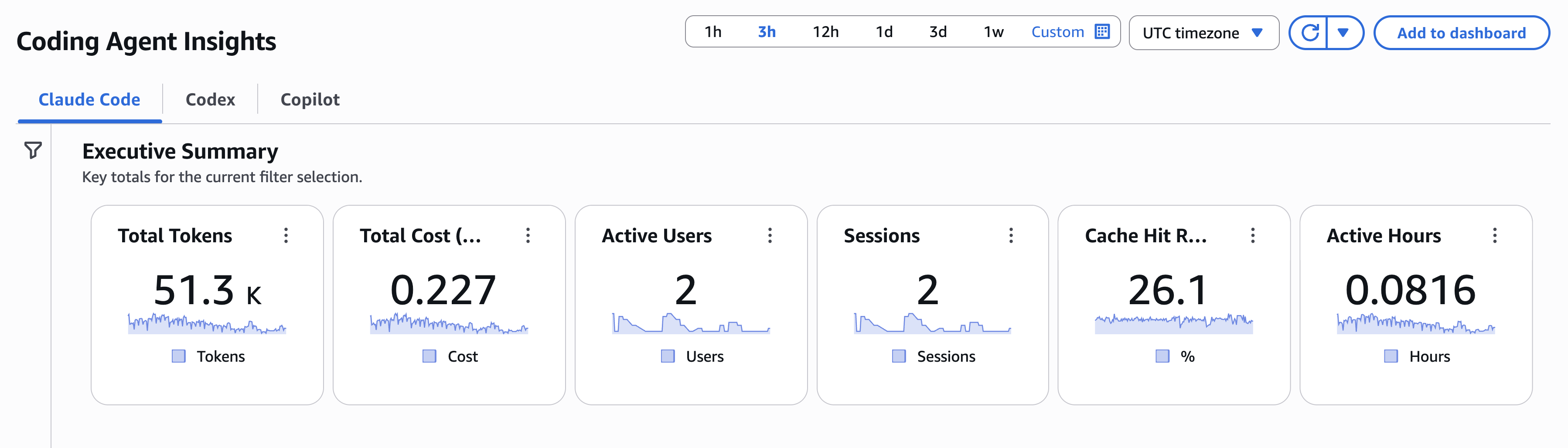
On July 20, 2026, Amazon CloudWatch launched Coding Agent Insights, a set of dashboards that give engineering leaders visibility into how AI coding tools are used across an organization. The feature reads OpenTelemetry metrics emitted directly by the coding agents and presents them next to existing CloudWatch operational data. It supports Claude Code through the Claude apps gateway for AWS, along with Codex and GitHub Copilot. Setup relies on bearer-token authentication with metrics shipped straight to CloudWatch, so there are no collectors or sidecars to run. Availability covers all AWS commercial regions except the UAE, Bahrain, and Israel, priced at standard CloudWatch metric ingestion rates.
The dashboards group usage by developer, team, department, and cost center, using OpenTelemetry resource attributes passed through an environment variable. Leaders can see token consumption split into input, output, and cache operations, alongside spend trends and proactive token billing alerts. On the output side, CloudWatch surfaces commits, active coding hours, lines added and removed, and pull requests, each broken down by the grouping you choose. It also exposes code-quality signals such as accept and reject ratios for suggested edits and language distribution. The pitch is simple: model cost-to-output ratios per workload and right-size token budgets across departments from one console.
Why token spend became a leadership problem
Agentic coding tools bill by token, and consumption climbs fast once agents run multi-step tasks, spawn sub-agents, and re-read large contexts. A team that standardized on seat licenses a year ago now faces a variable, per-run cost that few finance functions know how to forecast. That volatility is what pushes AI coding from an engineering curiosity to a board-visible line item. When a single engineer can burn hundreds of dollars in an afternoon of aggressive agent use, the question stops being whether the tools help and starts being where the money goes and what it buys. Coding Agent Insights is AWS answering that question inside the console teams already pay for.
The timing tracks a broader shift in how engineering orgs govern AI. Leaders have spent 2026 trying to attach real numbers to adoption claims, and most lacked the instrumentation to do it. Emitting metrics over OpenTelemetry means the data model is portable and vendor-neutral, so the same pipeline can feed CloudWatch today and a different backend later. For a VP of Engineering, that portability matters as much as the dashboards. It lets you measure agent spend and output without committing your telemetry to any one tool, which is the kind of optionality that survives the next budget cycle and the next vendor negotiation.
The OpenTelemetry bet under the hood
The design choice worth noting is that AWS did not build a proprietary agent for this. Coding Agent Insights consumes OpenTelemetry metrics the agents already produce, which means the standard is doing the heavy lifting. Claude Code, Codex, and Copilot each expose usage telemetry, and CloudWatch simply ingests it with bearer-token auth and organizes it. That keeps the integration thin and makes it easy for AWS to add new agents as they adopt the same conventions. It also means a team on Datadog, Grafana, or a homegrown stack can point the same metric stream elsewhere and reproduce most of the value without touching CloudWatch at all.
This is the practical payoff of OpenTelemetry reaching into agent territory. A year ago, measuring coding-agent usage meant scraping vendor billing exports and reconciling them by hand. Now the agents speak a common metrics dialect, and the observability layer treats coding activity like any other workload signal. For platform teams, that collapses a bespoke reporting project into a configuration task. The dashboards ship with the grouping and filtering already wired to resource attributes, so the work is naming your teams and cost centers correctly at the source. Get that taxonomy right once and the attribution flows through to every chart automatically.
What the dashboards measure, and what they miss
The output metrics are honest about being activity counts. Commits, pull requests, and lines of code are easy to capture and easy to game, and none of them certify that shipped work was correct, maintainable, or valuable. CloudWatch presents them because they are what the agents emit, and they do correlate loosely with throughput. A leader reading these charts should treat a rise in PR velocity as a prompt to investigate rather than a verdict on impact. The accept and reject ratios for suggested edits are more interesting, because they hint at whether developers trust the agent's output or are constantly overriding it, which is a signal about fit as much as volume.
The gap this leaves is quality and downstream cost. A team can post impressive commit throughput while quietly accumulating review burden, flaky tests, and rework that shows up two sprints later. Coding Agent Insights does not close that loop, and it does not pretend to. The right move is to pair its spend and activity data with your own delivery and reliability metrics: change failure rate, review latency, incident volume. Read together, they tell you whether token dollars are buying durable output or just faster motion. Read alone, the productivity tiles can flatter a rollout that is quietly creating work while it appears to remove it.
The build-versus-buy question it reopens
A cohort of developer-productivity vendors has grown up around exactly this problem: attributing AI coding spend and output across an engineering org. CloudWatch now offers a native version of the core reporting for teams already standardized on AWS observability. That does not make the specialist tools redundant, because they layer survey data, benchmarking, and research-grade analysis on top of raw metrics. It does change the buying conversation. If your main requirement is spend attribution and budget alerts, you may already own the capability inside your CloudWatch bill and simply need to switch it on.
For engineering leaders, the decision turns on how much interpretation you need. Teams that want defensible, cross-company benchmarks and opinionated frameworks will keep paying a vendor to provide them. Teams that mainly need to see where tokens go, catch overspend early, and correlate agent use with their own delivery data can start with what AWS ships and expand only if the gaps hurt. Either way, the announcement raises the floor. Basic AI coding financial governance is now a default feature of a major cloud platform, which means going without any measurement at all becomes harder to defend at your next planning review.
What to do before you switch it on
The prerequisite is a clean organizational taxonomy at the telemetry source. The dashboards are only as useful as the resource attributes you set, so agree on how teams, departments, and cost centers map to real accountability before the data starts flowing. Retrofitting that mapping after months of unattributed metrics is painful, and it undermines trust in the numbers when a director cannot reconcile their team's spend. Treat the rollout like any other observability project: define the dimensions, instrument consistently, and validate that a sample of runs lands in the right buckets. The reward is that every future question about agent cost has a single, agreed answer.
Then decide what threshold triggers action. Proactive token billing alerts are worthwhile only if someone owns the response and knows what a healthy burn rate looks like for each team. Set provisional budgets, watch them for a few weeks, and adjust once you see a real relationship between spend and delivery. The dashboard is only the means. The real prize is turning AI coding into a governed, forecastable capability that finance and engineering can discuss with shared data, which is the state most orgs still lack halfway through the agentic-coding transition.


