A Shelf-Intelligence Bet Goes Horizontal
Augmodo announced on July 13, 2026 that it raised $21 million at a $350 million valuation, with existing backer TQ Ventures leading and Lerer Hippeau, Jefferson River Capital, Arena Holdings, Chemist Warehouse, New Fare, Interlace, and Webb Investment Network joining. The Seattle company made its name in retail, equipping store associates with wearable cameras that continuously track what is on the shelf. The new capital is explicitly aimed at pushing that capability outward, into warehouses, factories, and other environments where knowing the real-time state of physical space carries value. CEO Ross Finman framed the mission bluntly, describing Augmodo as an AI system for the physical workforce.
We find the pivot instructive because it reflects a broader realization in retail technology. The hard problem was never analytics, it was capture: getting reliable, current data about the physical world without paying for expensive fixed infrastructure. Once a company solves capture cheaply, the same data pipeline applies far beyond the store. Augmodo is betting that a shelf-scanning wearable is really a general-purpose sensor for any place humans do physical work. That is an expansive claim, and the raise gives the company the runway to test whether retail was a beachhead or the whole market.
The Smartbadge And Realogram Approach
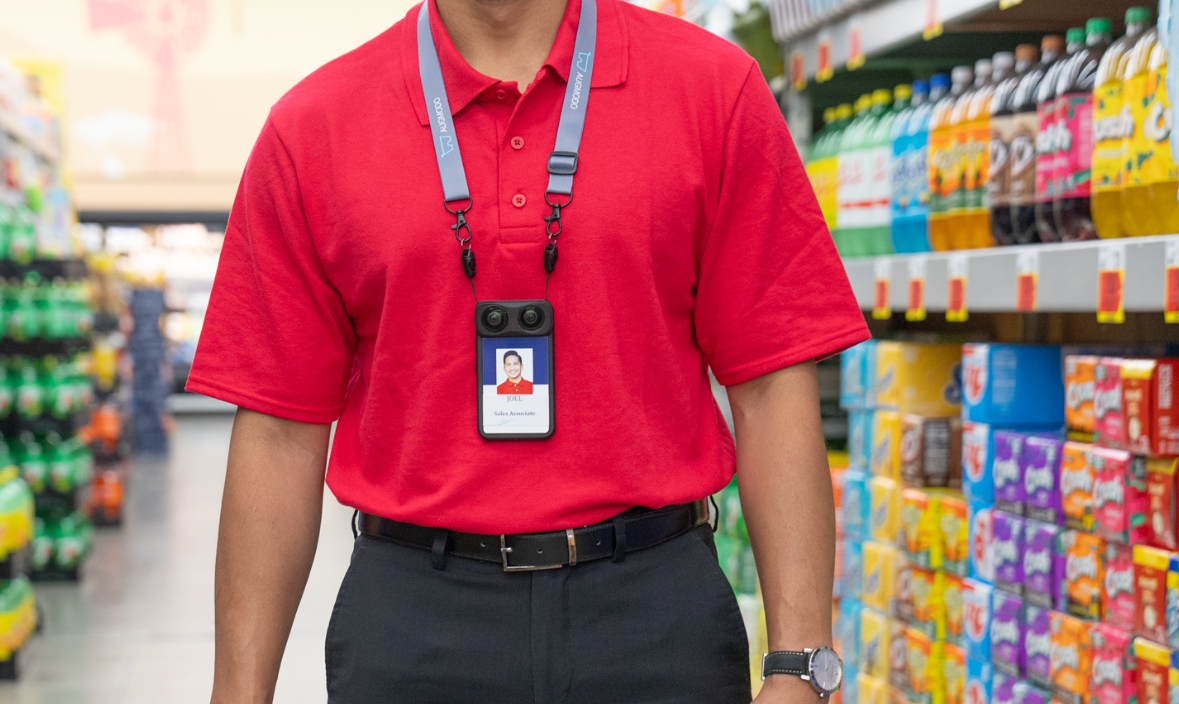
The core product is the Smartbadge, a wearable device with a camera that an associate clips on and wears through a normal shift. As the worker moves through the store, the badge captures the environment and feeds a computer vision pipeline that builds what Augmodo calls a Realogram, a live spatial map of where products actually sit versus where the planogram says they should. Managers use it to catch out-of-stocks, misplaced items, and compliance gaps without dispatching anyone to walk the aisles specifically to audit them.
The design sidesteps the two dominant alternatives in shelf monitoring. Fixed ceiling cameras are costly to install and cover only what they can see, while autonomous floor robots are expensive, conspicuous, and slow to roam a large store. A wearable rides on labor the retailer already deploys, so coverage scales with staffing and the marginal cost of another store is a badge and a subscription. The trade is that data quality depends on how associates move, which means coverage can be uneven. Augmodo's growth suggests that trade is acceptable to a meaningful set of retailers.
The Growth Figures Behind The Raise
Augmodo backed the round with operating numbers rather than vision alone. The company says revenue has grown tenfold over the past year, that it now maps more than 186 million square feet of retail space every month, and that it expects to cross one billion square feet per month by the end of the year. It is adding 50 to 100 new store locations monthly. Those figures describe a business scaling capture faster than most fixed-infrastructure competitors could, which is the entire point of the wearable model.
We treat vendor-supplied metrics with the usual skepticism, but the trajectory is coherent with the product design. Square footage mapped is a sensible proxy for adoption because it grows with both new locations and deeper penetration of existing ones. A tenfold revenue jump off a small base is easier than off a large one, so the more telling number is the location add rate, which points to repeatable sales rather than a few marquee logos. If Augmodo sustains 50 to 100 stores a month while opening non-retail verticals, the valuation step to $350 million looks earned rather than aspirational.
Why Investors Back The Physical Workforce Thesis
The pitch that won this round is that roughly 80% of the global workforce does physical work that software has barely touched. Knowledge work has been instrumented for two decades, while the person restocking a shelf, picking a warehouse order, or maintaining a facility generates almost no structured data. Augmodo argues that a wearable capture layer finally makes that work legible, and that the same computer vision models trained on retail shelves transfer to inventory in a warehouse or parts on a factory line. Investors including Chemist Warehouse, itself a retailer, are buying that transferability.
We think the thesis is directionally sound and commercially unproven at the edges. Retail shelves are a relatively structured environment with predictable product shapes and planograms to compare against. A hospital supply room or an automotive plant introduces messier visual conditions and different accuracy requirements. The models may transfer, or each vertical may demand its own training and its own sales motion. The capital gives Augmodo the ability to find out, and the presence of an operating retailer on the cap table suggests at least one large customer sees value beyond a pilot.
The Competitive Shelf-Monitoring Landscape
Augmodo is not alone in chasing real-time shelf data. Robot-based scanners, fixed-camera systems, and computer vision startups have all pursued the same prize, and grocers in particular have run visible trials of autonomous shelf-scanning hardware. The category has consolidated interest recently, with larger platforms acquiring computer vision capability to lock in shelf intelligence as a service. That backdrop matters for Augmodo because it means both competition and potential acquirers are circling the same problem it is solving.
The differentiator Augmodo is pressing is unit economics. If a wearable delivers usable shelf data at a fraction of the capital cost of robots or fixed rigs, it can win the mid-market and the long tail of stores that never justified heavier hardware. The vulnerability is depth of coverage and consistency, areas where a dedicated robot can outperform a distracted human wearing a badge. We expect the market to segment, with wearables winning breadth across many stores and fixed or robotic systems holding high-value locations that demand exhaustive, scheduled scans.
Our Read
Augmodo's raise is a credible endorsement of a pragmatic idea: instrument the physical workforce with cheap wearable capture rather than expensive fixed infrastructure. The retail results give the company a real foundation, and the growth figures, if they hold, justify the expansion beyond the store. For retail-tech leaders evaluating shelf intelligence, Augmodo is now a serious option to weigh against robots and camera networks, particularly for chains that want broad coverage without a heavy capital program.
The open questions are about transfer and durability. Whether retail-trained models generalize cleanly to warehouses and factories will determine if this is a large horizontal platform or a strong vertical retail tool with ambitions. We would also watch how Augmodo handles data governance as it captures ever more of the physical environment, since a badge that records everything an associate sees raises workforce and privacy considerations that scale with adoption. The company has bought itself the runway to answer these questions, and the next year of location adds will show which story is true.