What Wild Zebra raised and why
Wild Zebra closed a 6 million dollar Series A led by Trilogy Equity Partners, with participation from Tetherpoint Capital and angel investors including Shrikesh Majithia, bringing the company's total funding to 8 million dollars. Trilogy managing director Amy McCullough joined the board as part of the round. The product is an AI learning platform for math and reading aimed at students in grades 2 through 9, and the company says it has logged hundreds of thousands of tutoring conversations across tens of thousands of students so far.
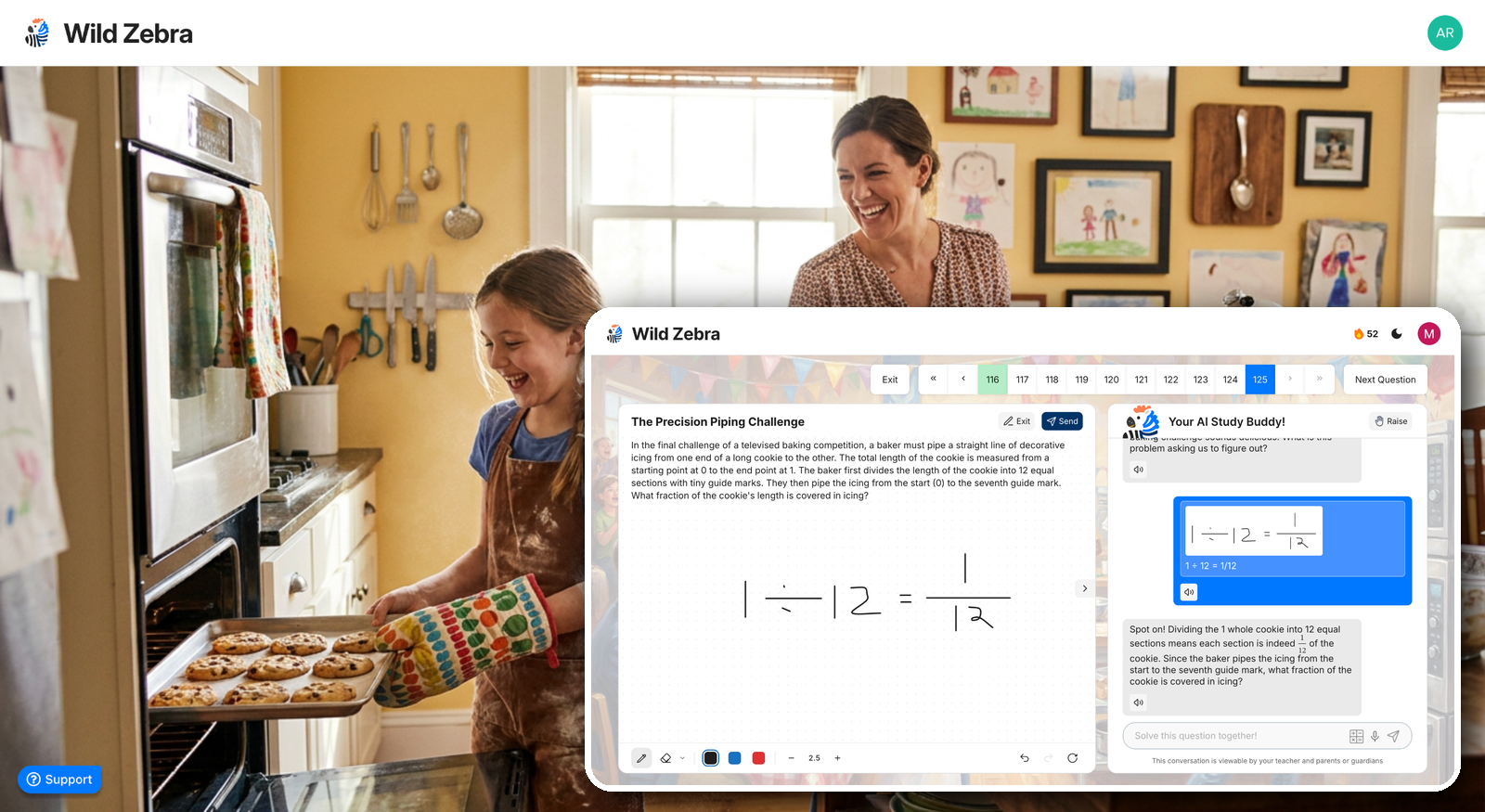
The mechanism is a Socratic method rather than an answer engine: the system asks students questions instead of solving problems for them, and it personalizes lesson content around a student's stated interests, sports, cooking, music, and similar hooks, to keep engagement up while working through the underlying skill gaps. The platform builds what the company calls a personalized learning tree that tracks mastery and surfaces where a specific student is stuck, rather than reducing progress to a single completion percentage.
The motivation design choice worth noting
CEO Edan Shahar described part of the product's philosophy as wanting "to catch kids being good, too," meaning the system is built to flag positive moments, persistence, curiosity, effort, to teachers and parents through dashboards, not just to flag errors or gaps. That is a specific design decision about what a tutoring tool optimizes for beyond correctness, and it echoes a broader pattern worth tracking across AI tools built for any coached or evaluated population, whether that population is students, new hires, or a customer support team learning a new workflow.
It is also a small, differentiated feature next to what the largest vendors are building. A startup with 8 million dollars in total funding competing on pedagogical nuance is a real strategy, but it is a strategy that lives or dies on whether districts value that nuance enough to run a second procurement process and a second vendor relationship alongside the free AI tools already arriving from OpenAI, Microsoft, and Google. Those three vendors are not currently marketing a dedicated Socratic-method tutoring product with the same specificity, which is exactly the gap Wild Zebra is trying to occupy before a platform vendor decides to close it with a feature update instead of an acquisition.
The build-versus-buy calculus this actually tests
Every district and every enterprise buyer evaluating a specialized AI vendor right now is running a version of the same math: does the specialized tool's advantage over the platform-bundled equivalent exceed the cost of managing an additional vendor relationship, contract, and data-sharing agreement. Wild Zebra's bet is that its tutoring-specific design, question-first pedagogy, interest-based personalization, mastery tracking, beats whatever tutoring feature a general-purpose AI platform ships as an add-on. That bet has worked for specialized vendors before in adjacent categories, but it becomes harder to defend as the incumbents' free tiers get more capable and cost nothing incremental to adopt.
The honest risk on the other side of that bet is vendor durability. An 8 million dollar total raise is enough to build and iterate a strong product, but it is a fraction of the balance sheet backing the platforms districts increasingly get tutoring features from at no additional cost. Any buyer signing a multi-year contract with a vendor at this funding stage should be underwriting the real possibility of an acquisition, a pivot, or a shutdown inside that contract term, not just the product's current feature set.
What this means beyond K-12
The same tension is playing out in enterprise software well beyond education: specialized AI point solutions competing against tutoring, coaching, or coaching-adjacent features that Microsoft, Google, and OpenAI are bundling into platforms customers already pay for. A specialized vendor's pedagogical or domain nuance is often genuinely better in the narrow case it was built for. The bundled alternative is often good enough, free at the margin, and backed by a vendor you are not adding a new contract to manage. That is the same calculus a CIO runs when evaluating a specialized sales-coaching AI against whatever comes bundled into the CRM.
The lesson from watching this pattern across categories is that point solutions win the technical comparison more often than they win the procurement decision, because procurement weighs vendor count, contract risk, and integration burden alongside feature quality. A specialized vendor that wants to survive this cycle needs a clear answer for why its narrow advantage is worth carrying a second vendor relationship, not just evidence that its product performs better in isolation.
The decision this puts on your desk
If you are evaluating a specialized AI vendor against a bundled feature from an incumbent platform you already pay for, run Wild Zebra's situation as a test case. Ask what the specialized tool does differently in its design, not its marketing, that the bundled alternative structurally cannot replicate, the way Wild Zebra's question-first pedagogy differs from a generic answer-generating chatbot. If you cannot name that structural difference specifically, the bundled option is very likely the safer and cheaper choice.
If you can name it, underwrite the vendor risk explicitly rather than ignoring it: build a contractual exit plan, insist on data portability, and size the contract to a timeline that does not assume a seed-stage or Series A company survives unchanged for five years. Wild Zebra may well be exactly the kind of specialized bet that pays off, and a fresh board seat from a growth-stage investor like Trilogy is a mild positive signal on governance. The point is that the payoff still depends on your own diligence about vendor durability during the contract term, not on the strength of the pedagogy alone.