What actually opened
Rainbow, a Chinese omnichannel retailer, reopened its Shahe sp@ce supermarket in Shenzhen's Nanshan District on September 8 as the company's first Store Digital Twin location. The store has served the same neighborhood for close to 17 years, which makes this a retrofit of an established, ordinary-volume grocery location rather than a showcase flagship built from scratch. That distinction matters for any retail CIO trying to gauge what this kind of instrumentation actually costs against a real-world store footprint rather than a demo environment engineered to impress visitors.
The headline figure is scale: more than 17,000 IoT devices integrated into a single supermarket, spanning shelf sensors, smart carts, electronic shelf labels, and back-of-house systems tied into an intelligent fulfillment center that supports both in-store shopping and home delivery. Rainbow built the store around a concept it calls City, Garden, Food Hall, with nine distinct experiential zones, but the technology stack underneath is the part with direct relevance to any grocery or big-box operator evaluating its own store-modernization roadmap.
The cart and the shelf are now the same system
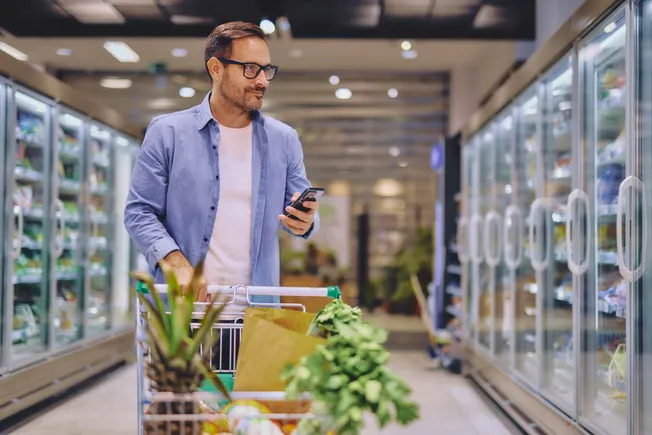
The store's smart carts, built on Hanshow's NexConnect platform, are integrated with Lingzhi, an AI shopping assistant that provides product information, in-store navigation, and promotional offers directly through the cart itself. That folds a function retailers have historically bolted on as a separate app, in-aisle wayfinding, into hardware the shopper is already pushing anyway, which removes a step that has consistently limited adoption of standalone navigation apps in Western grocery pilots, where shoppers rarely bother opening a second app for a single trip through a single store.
On the shelf side, Hanshow's Nebular Ultra electronic shelf labels support centimetre-level product positioning with interactive functionality, letting a shopper pull product detail and traceability information directly from the label. Paired with AI and robotics handling out-of-shelf identification and merchandising management, the store is automating two functions that most Western grocers still run manually: knowing exactly what is out of stock in real time, and verifying that shelf execution matches the planogram. Both are currently store-walk checklist items at most chains, done by a human with a clipboard or a handheld scanner on a fixed schedule rather than continuously by sensors.
Who actually built this
The technology stack is a three-way collaboration: Hanshow supplied the hardware, including the smart carts and shelf labels; Lingzhi Digital Technology, Rainbow's own technology subsidiary, contributed the underlying Bailingniao retail AI model that powers the shopping assistant; and Rainbow Digital Commercial ran the retail operations integration. That structure is notable because Rainbow did not simply buy a vendor's AI layer wholesale, it built its own model in-house through a dedicated subsidiary and paired it with a hardware partner's sensor and cart infrastructure.
Rainbow Digital Commercial Chairman Xiao Zhanglin framed the goal as building a better everyday shopping experience around quality, freshness, transparency, and trust rather than novelty for its own sake. That framing, emphasizing traceability and freshness over gimmick, is a useful signal for any grocery CIO weighing whether shelf-level IoT investment needs to justify itself through operational metrics like shrink and out-of-stock reduction rather than through customer-facing spectacle alone. It also suggests Rainbow is measuring the rollout against the same operational KPIs a Western grocery finance team would recognize.
Why this is a build-versus-buy story, not just a hardware story
Most Western retailers evaluating electronic shelf labels or smart-cart pilots are choosing between established vendors and treating the AI layer as something that comes bundled with the hardware purchase. Rainbow's approach, building its own AI model through a dedicated subsidiary while sourcing hardware from Hanshow, splits that decision into two separate tracks. For a large grocery chain with the scale to justify an internal AI team, that split may be the more defensible long-term path, since it keeps the retailer's shopper-behavior data and model tuning in-house even as the physical sensor and cart hardware stays vendor-supplied.
For most mid-size grocers, though, the fully vendor-bundled path Rainbow avoided is still the realistic option, and Rainbow's own scale, backed by a dedicated technology subsidiary, is not something a typical regional chain can replicate. The 17,000-device figure is useful less as a target to hit and more as a ceiling that shows how far shelf-and-cart instrumentation can go once a retailer commits fully, giving CIOs at smaller chains a benchmark for how much headroom exists above whatever pilot scope they are currently running.
What Western grocers should take from it
The most exportable piece of this rollout is not the 17,000-device figure itself but the specific pairing of centimetre-level shelf label positioning with continuous out-of-shelf detection. That combination directly attacks two of the most persistent, hard-to-quantify losses in grocery operations, phantom inventory and shelf execution drift, both of which currently rely on periodic human checks rather than continuous sensing at most U.S. and European chains, and both of which tend to erode margin quietly enough that finance teams rarely trace the loss back to its actual operational cause.
The retrofit context is the second takeaway worth internalizing: Rainbow proved this stack works inside a nearly 17-year-old existing store footprint, not just a purpose-built new location. That lowers the bar for any grocery CIO who assumed this level of instrumentation required ground-up construction, since it suggests existing store fleets are viable candidates for phased retrofit rather than requiring an entirely new store-development pipeline before any of this technology can be deployed at scale.
The bigger picture
Rainbow's launch lands amid a broader wave of store-level AI and IoT investment across Asian retail that has consistently outpaced comparable rollouts in the U.S. and Europe, particularly around electronic shelf labels and computer-vision-based shelf monitoring. Western grocers evaluating their own next-generation store formats now have a concrete, publicly documented reference point for what a fully instrumented store looks like running in production, with real foot traffic and a real SKU count, rather than staged inside a vendor's pitch deck or a single showcase location built purely for demonstrations.
The open question for any CIO studying this rollout is sequencing: whether to pursue smart carts, shelf labels, and out-of-shelf detection as a single integrated program the way Rainbow did, or to stage them independently and let each prove its own ROI before committing to the next layer. Rainbow's all-at-once approach worked because it had a dedicated AI subsidiary and a hardware partner already in place. Most Western grocery IT organizations will need to make that sequencing call explicitly rather than assuming an integrated rollout is the default path.