The New Battleground for Data Platforms
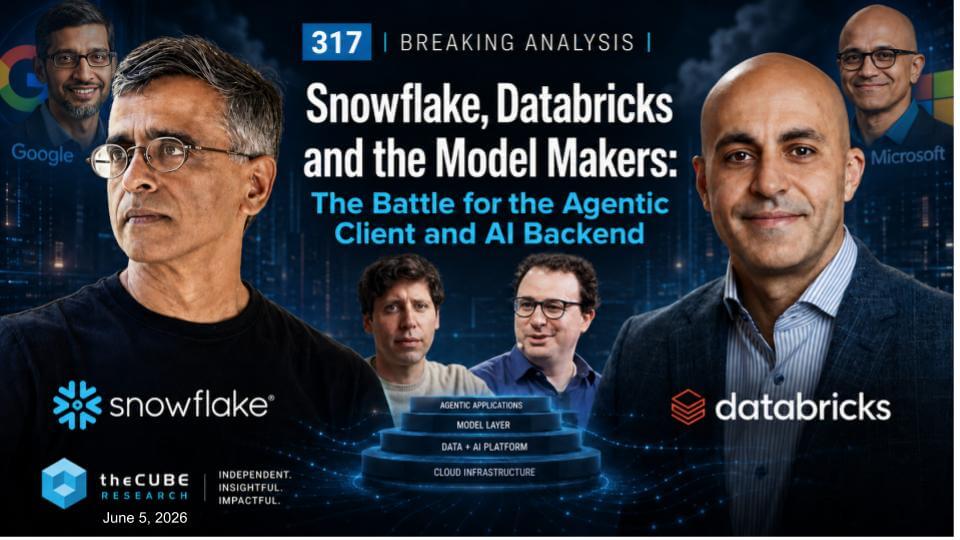
For a decade the Snowflake and Databricks rivalry was fought over architecture: warehouse versus lakehouse, proprietary format versus open table format, SQL performance versus machine-learning flexibility. A new analysis argues that battle is largely over and a more consequential one has begun. The real prize now, the argument goes, is not where data is stored but who owns the interface through which people and agents work with it, and the intelligent back end that makes that work productive. The competition has moved up the stack, from the plumbing of data to the experience and intelligence layered on top of it.
This reframing matters because it changes what these companies are actually selling. A data platform used to compete on how fast and cheaply it could store and query information. An agentic data platform competes on how well it can ground autonomous agents in trusted business context and let them act. That shift pulls Snowflake and Databricks out of a narrow infrastructure fight and into direct competition with model makers and application vendors. The question is no longer whose engine is faster; it is whose platform becomes the place where enterprise agents live, learn, and execute the work that data was always meant to inform.
Two Layers, One Feedback Loop
The analysis frames the contest around two interconnected layers. The first is the agentic client, the surface where users and agents do their work. The second is what it calls the system of intelligence, the back end that holds the governed data, metadata, and learned context the agents draw on. The central thesis is that these two layers have to be co-designed, because each teaches the other. The client generates traces of how agents and people actually work, and those traces refine the back end, which in turn makes the client smarter. Winners, the argument holds, will be decided by the tightest feedback loop between the two.
That feedback loop is the strategic crux. As one observation in the analysis puts it, the system of intelligence is part specified and part learned: some of it is deliberately programmed, and some emerges through usage. A vendor that controls both the client and the back end captures that learning loop end to end, compounding an advantage with every interaction. A vendor that controls only one half is dependent on someone else for the other, and leaks the learning. This is why both Snowflake and Databricks are racing to own the full stack rather than ceding the interface to a model maker or the data to an application.
Snowflake's Client Gambit
Snowflake's response has been to put a coherent set of clients and context services on the board, often by rebranding and extending what it already had. Its business-user interface, formerly Snowflake Intelligence, is now CoWork, while its developer-facing tool, previously Cortex Code, has become CoCo. Underneath those clients sit the services meant to make them trustworthy: Horizon Context as a governance and metadata layer, and Cortex Sense aimed at capturing institutional memory and the tacit knowledge that usually lives in people's heads. The company also moved to strengthen agent observability through its acquisition of Observe, plugging a gap in monitoring how agents actually behave.
Read together, these pieces are an attempt to own both layers of the feedback loop at once. CoWork and CoCo are the client; Horizon Context, Cortex Sense, and the observability tooling are the system of intelligence and the instrumentation around it. The bet is that enterprises will prefer a single vendor that governs the data, hosts the agents, and watches what they do, rather than stitching those functions together across providers. Whether the rebranded clients win user loyalty is an open question, but the strategic logic is clear: Snowflake is trying to keep the learning loop inside its own walls.
Databricks and the Model Makers
Databricks is pursuing the same prize from its own strengths, leading with Genie as its agentic interface and leaning on the data engineering and machine-learning heritage that made it formidable in the first place. But the more interesting dynamic in the analysis is that the data platforms are no longer fighting only each other. The model makers have entered the same arena. OpenAI with ChatGPT and Codex, Anthropic with Claude and its own collaborative client, Google with Gemini Enterprise, and Microsoft with Copilot are all building enterprise clients that sit exactly where Snowflake and Databricks want to be. The competitor set has expanded well beyond the familiar two-horse race.
That convergence sets up a genuinely multi-front war. The data platforms own the governed enterprise data but must build credible agentic clients and intelligence layers on top. The model makers own the most capable models and increasingly compelling clients but must earn trusted access to enterprise data they do not hold. A long list of incumbents, from Salesforce and SAP to ServiceNow, Oracle, and Workday, brings the workflows and the systems of record. Each camp starts from a different strength and is racing to assemble the rest. The enterprise agentic stack is being contested from every direction at once, and no one yet owns the whole loop.
Governance as the Moat
If capability is converging and clients are proliferating, what becomes the durable advantage? The analysis points to governance, metadata, and observability as the emerging moats, and that conclusion fits the realities of enterprise buying. A frontier model is increasingly a commodity that any competitor can match within months. Trusted, governed access to an organization's own data, with the lineage, permissions, and context that make an agent's actions safe and auditable, is far harder to replicate. It is built up over years inside a specific company's data estate, and it is exactly what enterprises are most nervous about handing to an autonomous system.
This is the layer where the data platforms have a structural edge over the pure model makers, and they know it. Snowflake's Horizon Context and Cortex Sense, and the governance and catalog investments across the field, are all attempts to make trusted context the thing customers cannot easily get elsewhere. A model maker with a brilliant client still has to solve for governed data access; a data platform that already governs the data has a head start on the trust that agentic deployments require. In a market where models are abundant and increasingly interchangeable, the company that owns the governed context may own the customer.
What CDOs Should Watch
For chief data officers, the practical signal in all this noise is to stop evaluating these platforms as warehouses and start evaluating them as agentic operating environments. The questions that matter are shifting. How well does the platform ground agents in governed, trusted context? Can it observe and audit what agents actually do once deployed? How tightly is the client integrated with the intelligence back end, and how portable is the result if you want to change vendors later? Those questions cut closer to where value and risk now sit than the old benchmarks of query speed and storage cost ever did.
Our read is that the analysis is directionally right: the contest has moved to the agentic client and the system of intelligence, and governance is the most defensible ground in it. But CDOs should be wary of the lock-in this strategy is designed to create. The whole point of owning both layers and the feedback loop between them is to make the customer's intelligence inseparable from one vendor's platform. That is great for the winner and potentially costly for the buyer. The smart posture is to embrace the agentic shift while insisting on open formats, portable metadata, and clear observability, so the learning loop serves the enterprise rather than quietly trapping it.